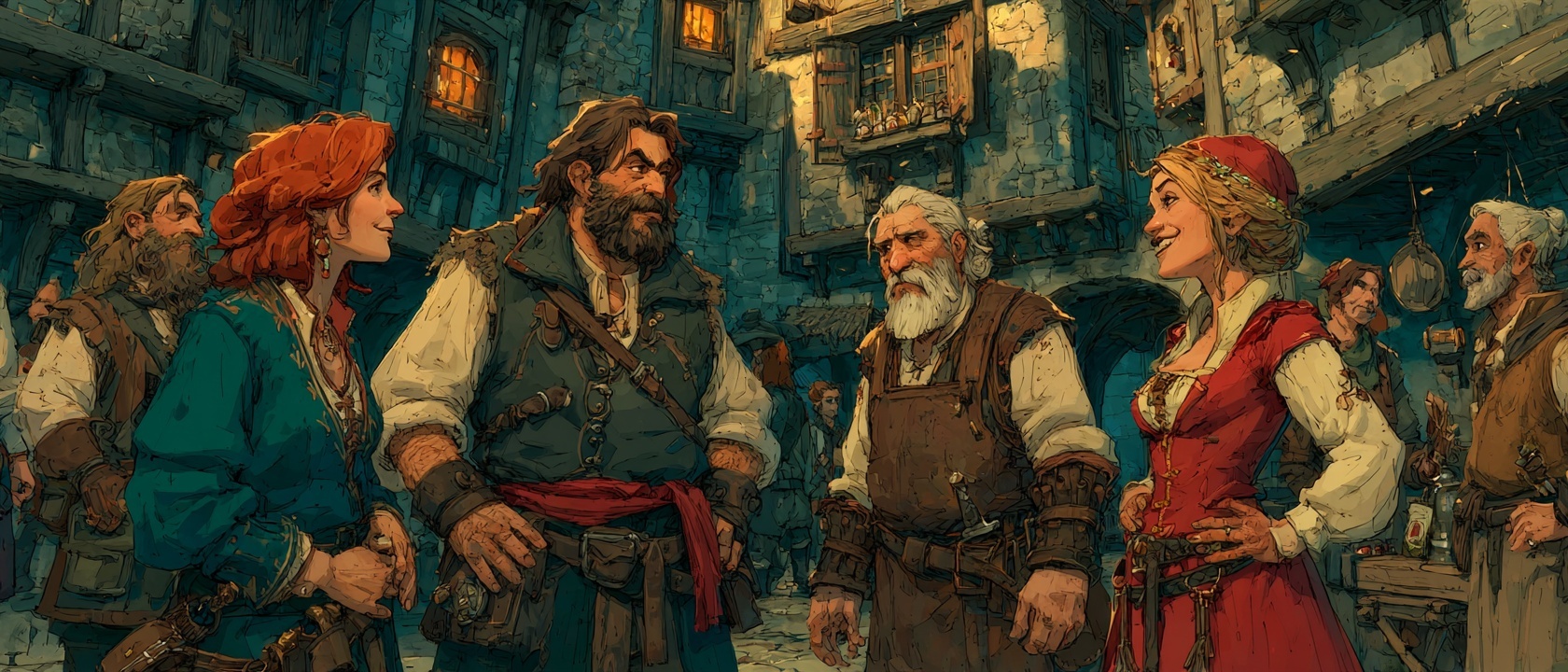
Wanderfolk is a medieval village survival RPG launching on Steam where every NPC is powered by AI with persistent memory. Villagers remember your conversations across sessions, form opinions about you, spread gossip through social networks, and can permanently banish you from the village. It is one of the first playable games with a full AI NPC conversation, memory, and reputation system in production.
What Makes AI NPCs Different from Scripted NPCs
Traditional RPG NPCs follow dialogue trees — branching scripts where every possible response is pre-written. The blacksmith says the same lines on day 1 and day 100. He doesn't know you saved his village. He doesn't care that you broke a promise to his friend.
AI NPCs generate dialogue in real time using large language models. In Wanderfolk, each NPC has a procedurally generated identity — a role (one of 37), a personality built from trait combinations, a backstory, and a voice type. When you talk to them, the AI receives all of this context plus your conversation history and reputation, and generates a response that's unique to that moment.
The difference is that you can say anything. Ask the blacksmith about his childhood. Lie to the shopkeeper about where you found a rare gem. Promise the elder you'll defend the village and then don't show up. The AI responds contextually to whatever you say — and remembers it.
How Wanderfolk's AI NPC Memory Works
Every conversation in Wanderfolk is summarized and stored as a vector embedding in a PostgreSQL database using the pgvector extension. Each memory captures the content, emotional sentiment, importance score, and timestamp.
When you talk to an NPC again, the system retrieves the most relevant past memories via cosine similarity search. If you promised the blacksmith iron ore three days ago, that promise surfaces automatically when you visit his forge. If you mentioned your fear of dungeons to the herbalist, she might bring it up when you ask about potions.
This is fundamentally different from flag-based memory (where the game tracks "quest_iron_promised = true"). Vector memory retrieves contextually — whatever you're currently discussing triggers retrieval of the most relevant past interactions, even across dozens of conversations. Learn more in our technical deep-dive on AI NPC systems.
Reputation and Gossip: Social Consequences
Memory alone isn't enough — what matters is what NPCs do with their memories. In Wanderfolk, every NPC tracks a reputation score from -100 (enemy) to +100 (beloved). Your reputation changes based on conversations, kept or broken promises, gifts, insults, and actions like defending the village or stealing.
Reputation has concrete effects: shop prices change, job offers unlock or disappear, NPCs share information or withhold it, and at the extremes, NPCs can refuse to speak to you entirely. If your global reputation across a village drops below -90, you're banished — and banishment is game over.
The gossip system makes this social. NPCs share their opinions of you through a social graph. Insult the shopkeeper and within a few game-days, the elder, blacksmith, and herbalist have heard about it. Negative reputation spreads ~30% faster than positive — bad news travels fast in a small village.
How Other Games Handle AI NPCs
The games industry is early in adopting AI NPCs. Here's where the field stands:
- Nvidia ACE (2023-2024) — technology demos showing AI-driven NPC speech and facial animation. Impressive tech, not yet in released consumer games.
- Inworld AI — middleware platform for adding AI NPCs to games. Used in some demos and indie projects. Focuses on character engines rather than game-integrated memory and reputation.
- Modded Skyrim/Fallout — community mods like Mantella add LLM-powered conversation to existing NPCs, but without persistent memory or reputation systems.
- AI Dungeon / Character.AI — freeform AI conversation platforms, but not games with integrated mechanics, progression, or consequences.
- Wanderfolk — a Steam-bound medieval survival RPG with AI NPCs integrated into every game system: persistent vector memory, reputation tracking, gossip propagation, autonomous simulation, and banishment. The AI isn't a layer on top — it's the core mechanic.
Beyond Conversation: Autonomous NPC Simulation
Wanderfolk's AI NPCs don't just respond to you — they live their own lives. The autonomous simulation runs daily updates where NPCs form relationships, make promises to each other, argue over resources, and react to village events. The commitment system tracks NPC-to-NPC promises with deadlines and consequences.
When you return to a village after time away, the social landscape may have shifted. New alliances formed, old friendships cooled, promises kept or broken. You can learn about what happened through conversation — NPCs reference events you weren't present for.
Frequently Asked Questions
What games have AI NPCs that remember conversations?
Wanderfolk is a medieval RPG where every NPC is powered by AI with persistent vector-based memory. NPCs remember your conversations across sessions using vector embeddings stored in a PostgreSQL database with pgvector. Other games exploring AI NPCs include Nvidia ACE demos and various indie prototypes, but Wanderfolk is one of the few playable games with full AI NPC conversation, memory, and gossip systems live in production.
How do AI NPCs work in games?
AI NPCs use large language models (LLMs) to generate dialogue instead of scripted dialogue trees. In Wanderfolk, each NPC has a personality, backstory, role, and opinion of the player. Past conversations are summarized, embedded as vectors, and retrieved via cosine similarity search when relevant. This means an NPC can reference something you said 10 game-days ago if the topic comes up again.
Can AI NPCs replace scripted dialogue in RPGs?
AI NPCs offer freeform conversation that scripted dialogue cannot match — you can say anything and get a contextual response. The tradeoff is less control over narrative pacing. Wanderfolk solves this by combining AI dialogue with structured game systems: reputation scores, gossip networks, job unlocks, and banishment conditions create meaningful consequences from conversations without requiring a script.
Is Wanderfolk the only game with AI NPC memory?
Wanderfolk is one of the first released games with a production AI NPC memory system. Each NPC stores conversation summaries as vector embeddings and retrieves the most relevant memories via cosine similarity when you talk to them. The game also features a gossip network where reputation changes propagate between NPCs through social connections.
Do AI NPCs in Wanderfolk use ChatGPT?
Wanderfolk uses xAI Grok as its AI backbone, not ChatGPT. Each NPC conversation sends the NPC personality, current reputation, retrieved memories, time of day, and recent events to the Grok API, which generates an in-character response. The system is designed for contextual roleplay, not general-purpose chat.
See AI NPCs in Wanderfolk on Steam
Wanderfolk launches on Steam for Windows and macOS. Every conversation is unique because it's generated by AI in real time. The best way to understand AI NPCs is to have a conversation with one.
Explore More
- 10 Best AI NPC Games in 2026 — comprehensive roundup with comparison table
- 7 Games Where NPCs Actually Remember You — NPC memory systems compared
- Best AI Chat Games — games where you chat freely with AI characters
- AI RPG Games — RPGs where AI powers the characters and stories
- Games Like AI Dungeon — alternatives with better memory and gameplay
- Wanderfolk vs AI Dungeon — living world vs text adventure
- AI NPCs in Games: State of the Art — industry overview and what's next