8 Best AI Chat Games — Talk to AI Characters With Real Consequences
Games where AI conversation isn't a gimmick — it's the core mechanic.
AI chat games let you type or speak freely to AI-powered characters instead of picking from dialogue trees. The best ones go beyond novelty — conversations have memory, context, and consequences. Wanderfolk is a medieval village survival RPG launching on Steam where every NPC is powered by AI with persistent memory, reputation tracking, and a gossip network that spreads your words through the village. Below are eight games that make AI conversation the core experience.
1. Wanderfolk
AI Chat + Persistent Memory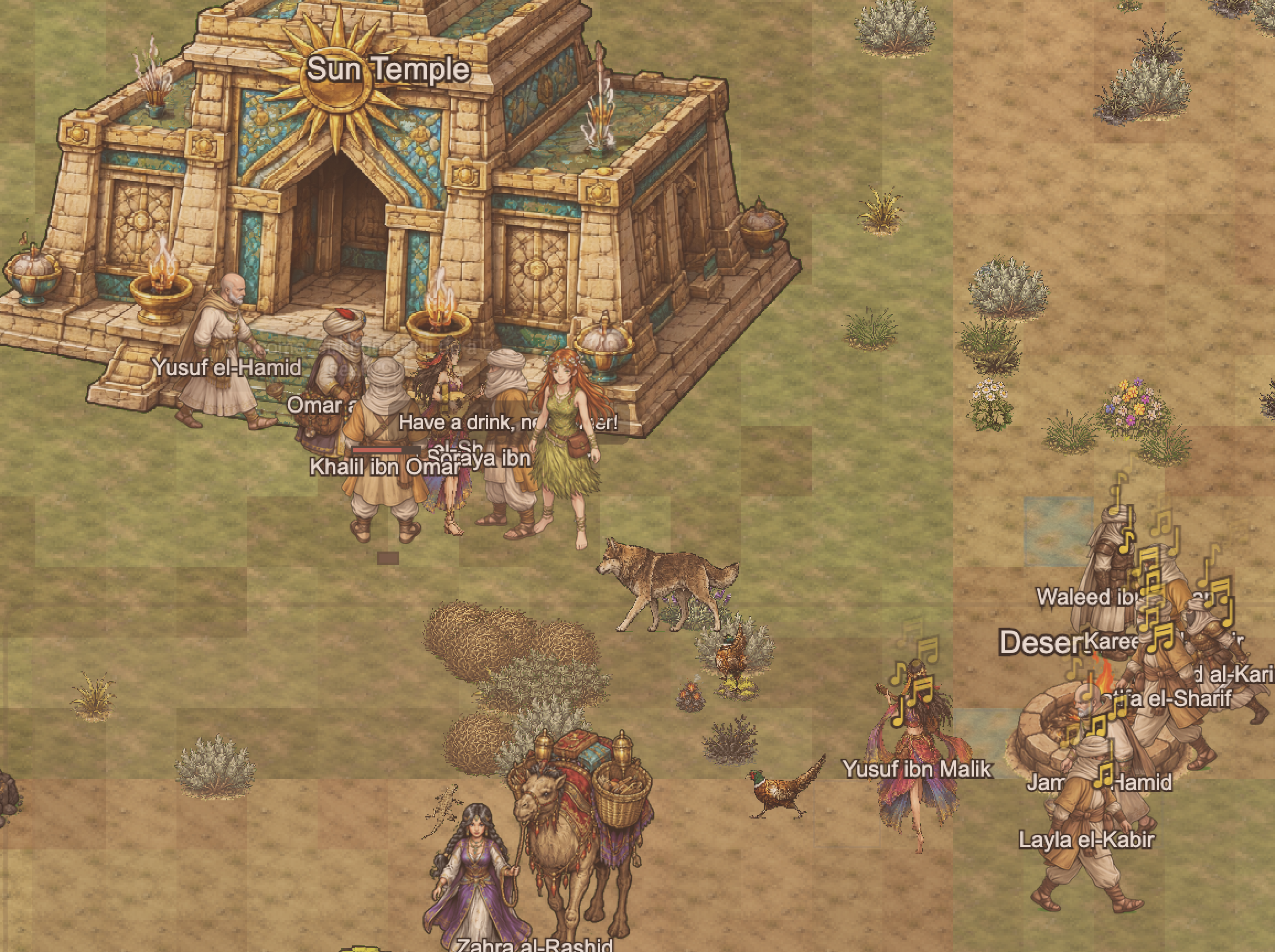
Wanderfolk is a medieval village survival RPG where every NPC is a fully autonomous AI character — and the chat is where it shines. There are no dialogue trees, no pre-written options. You type whatever you want into a chat panel, and the AI responds in character. The first time you try it, most people test the boundaries: they ask something weird, say something rude, or try to break the NPC. The NPC doesn't break. It responds like a person would — surprised, offended, amused, or concerned, depending on who they are and what you said. That moment of "wait, it actually understood me" is what hooks people.
The chat quality comes from how much context each NPC carries. Every character has a distinct personality, backstory, daily routine, and opinion of you. Tell the innkeeper you're afraid of the dark and she might offer you a lantern. Compliment the blacksmith's work and he warms up over time — start asking about apprenticeships and he'll remember you were the one who showed genuine interest. Insult the elder in front of the village and watch how cold every subsequent conversation becomes, not just with him but with everyone who heard about it. The AI doesn't just process your words in isolation; it weighs them against everything it knows about you and the character you're talking to.
What separates Wanderfolk from other AI chat games is that conversations have persistent memory — NPCs recall what you discussed days or weeks later if the topic comes up again. A reputation system tracks how each villager feels about you on a scale from enemy to beloved, and a gossip network means your words spread through the village whether you want them to or not. Push too many people too far and you get banished — game over. This makes every chat feel like it matters, not because the game tells you it matters, but because you can feel the village responding to the kind of person you've been.
Platform: Steam (Windows, macOS) · Steam store page
2. Suck Up!
AI Chat + Social Deception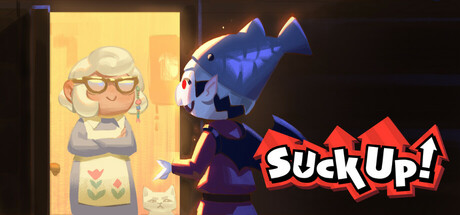
Suck Up! is proof that AI chat can be the entire game. You play as a vampire going door-to-door in a neighborhood, and your only tool is conversation. Each resident is powered by GPT, and you interact using your actual microphone — the game transcribes your speech and feeds it to the AI. Your goal is to convince each NPC to invite you inside so you can drink their blood. Simple premise, but the AI makes every attempt unpredictable. A paranoid neighbor won't open the door no matter how friendly you sound — you have to figure out the exact angle that cracks their defenses. A teenager sees through every disguise and calls you out with brutal honesty. A lonely widower just wants someone to talk to, and the guilt of exploiting that is entirely on you.
The chat feels remarkably natural because of the voice integration. Speaking to characters rather than typing changes the dynamic completely — you stumble over words, improvise, react to unexpected responses in real time. NPCs have distinct suspicion thresholds and personality types that determine how they respond to persuasion, intimidation, sympathy, and humor. The AI doesn't just process your words; it tracks your overall approach and adjusts. Get caught contradicting yourself and the NPC's trust drops permanently for that attempt. Multiple game modes — including Love Bites (breaking up couples at a party) and rap battles — extend the core mechanic in creative directions.
The limitation is memory scope. NPCs remember your conversation within a single visit, but there's no persistent cross-session memory. Each night is a fresh start. The game also occasionally produces responses that feel generic when the AI can't quite parse an unusual approach. But for pure AI chat as gameplay, Suck Up! is one of the most polished and consistently fun implementations available.
Platform: PC (Steam) · ~$13 USD
3. AI Dungeon
AI Chat + Text Adventure
AI Dungeon is where this entire genre started. Launched in 2019 by Latitude, it remains the purest AI chat experience: type anything, and the AI generates the world around you. There are no graphics, no pre-built maps, no coded game mechanics — everything is text, and everything is generated. You can play a medieval knight, a space explorer, a detective, or a version of yourself who wakes up as a cat. The AI acts as narrator, every NPC, and the game engine simultaneously. If you want to try talking to a dragon about philosophy, nothing stops you.
The model tier system is what differentiates AI Dungeon from simpler chatbots. Free accounts use basic models with roughly 1,000-token context windows, which means the AI forgets what happened a few exchanges ago. Premium tiers ($9.99/month) unlock better models with longer context. The Ultra tier ($49.99/month) gives access to GPT-4 Turbo with up to 32,000 tokens of context — enough for the AI to maintain story coherence across extended adventures. Story Cards and World Info let you define persistent facts about characters and settings that the AI references regardless of context window size.
The tradeoff is that AI Dungeon is entirely text-based and has no integrated game systems. There's no inventory that tracks items mechanically, no reputation numbers, no coded combat — everything is narrative. The AI might say you found a magic sword, but nothing in the code tracks that sword. This makes it the most freeform AI chat game but also the least structured. When you want pure creative conversation with no constraints, AI Dungeon is unmatched. When you want your conversations to have mechanical consequences in a living world, you need something else.
Platform: Browser, iOS, Android · Free tier available, subscriptions up to $49.99/mo
4. Hidden Door
AI Chat + Tabletop RPG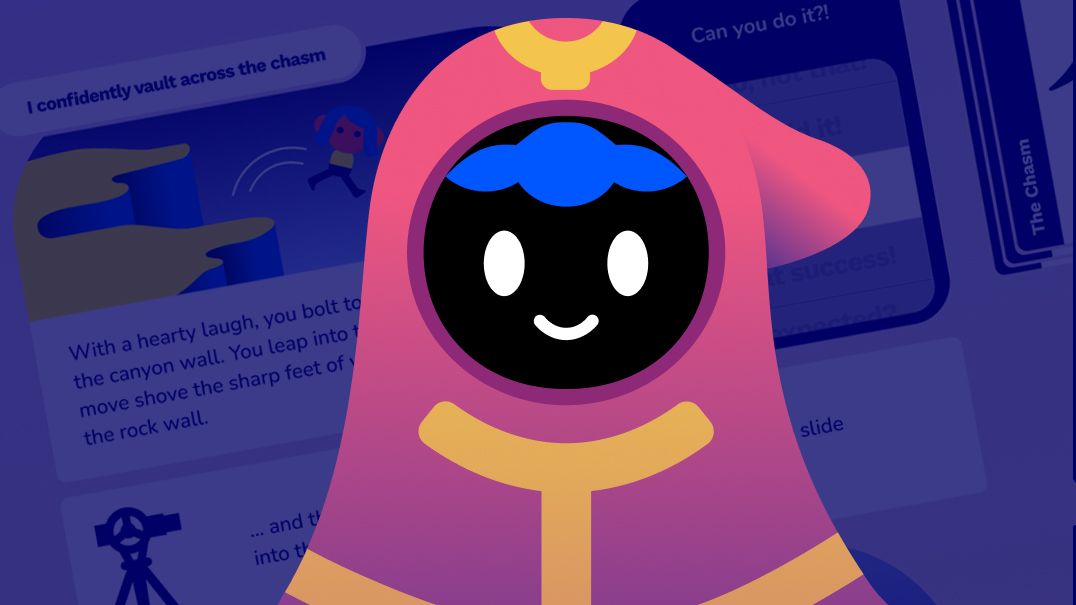
Hidden Door recreates the experience of playing a tabletop RPG with a skilled game master, except the GM is an AI. You choose a world — many are based on licensed properties like The Wizard of Oz, Dungeons & Dragons settings, or community-created universes — and the AI generates NPCs, locations, plot hooks, and consequences as you play. The presentation uses interactive graphic novel-style panels rather than pure text, giving it more visual personality than AI Dungeon without being a full graphical game.
The chat mechanic sits between freeform and structured. You type actions and dialogue naturally ("I threaten the guard with what I know about his captain" or "I bluff my way past by pretending to be a healer"), and the AI determines outcomes, generates NPC dialogue, and advances the story. The system runs actual game logic underneath the narrative — checking skill rolls, tracking health, managing inventory — so the AI isn't making everything up from nothing. This hybrid approach means conversations feel meaningful because there are real mechanics behind them, even if you interact through natural language.
Where Hidden Door excels is multiplayer. Playing with friends transforms the AI chat experience. You're not just talking to AI characters — you're collaborating with other players, improvising together, and watching the AI adapt to multiple unpredictable humans at once. The social dynamics between real players interacting with AI characters creates moments that neither pure AI chat nor traditional multiplayer can produce. The limitation is session-based memory — starting a new adventure means starting from scratch, and the AI doesn't carry relationships or consequences between sessions.
Platform: Browser · Free to play
5. Dead Meat
AI Chat + Horror
Dead Meat takes AI chat in a direction most games don't: high-stakes interrogation. You're investigating a conspiracy during a slasher scenario, and your primary tool is conversation. Over fifteen suspects, each powered by AI, respond to your questions in real time. You can ask anything — accuse someone directly, try to catch them in contradictions, build rapport to get them to open up, or play suspects against each other by revealing what others told you. The AI tracks emotional state, so a suspect who feels threatened responds differently than one who feels safe.
What makes the chat system compelling is the pressure. Unlike casual conversation games, Dead Meat puts you on a clock. Characters can die based on your decisions and the information you extract — or fail to extract — through conversation. This transforms the AI chat from a leisurely exploration into something genuinely tense. You're choosing your words carefully not because a reputation meter might shift, but because asking the wrong question at the wrong time might get someone killed. The game also supports mind-reading abilities that give you conversation advantages, adding a light game-mechanic layer on top of the freeform chat.
The game is still in development, so the full scope of the AI system isn't clear yet. Demos have shown strong AI responses with distinct character personalities and emotional reactions, but the memory model appears to be session-based. There's no persistent cross-session memory, and the AI occasionally produces responses that break character under unusual inputs. Still, as a concept, Dead Meat represents one of the most interesting applications of AI chat in games — conversation as survival mechanic.
Platform: PC (Steam) · Price TBA, releasing 2026
6. EmemeTown
AI Chat + Social Sim
EmemeTown approaches AI chat from the life-sim angle. You're dropped into a colorful cartoon town where every resident has an AI-driven personality. Conversations are generated in real time by an LLM, and the AI also drives facial expressions and body language from a library of over 1,000 motion types. The result is characters who don't just say interesting things — they physically react to what you're saying. Bring up a touchy subject and the NPC's posture shifts. Say something funny and they actually laugh with contextually appropriate animation.
The most interesting design choice is the "inner voice" mechanic. Rather than chatting directly with NPCs as yourself, you influence them by role-playing as their internal monologue. Whisper to the baker that he should ask the florist on a date. Convince the grumpy librarian that she actually likes the new neighbor. This creates soap-opera-style social dynamics where you're pulling strings rather than participating directly. NPCs also talk to each other autonomously, forming relationships and creating drama without your intervention — you're intervening in an already-active social simulation.
The chat quality is uneven in the way early-access AI games tend to be. Sometimes an NPC delivers a line so natural you forget it was generated — a baker nervously rehearsing what to say before confessing feelings, or a librarian passive-aggressively complaining about noise in a way that feels distinctly her. Other times the AI loops or loses the thread mid-conversation. The relationship memory is present but shallow, tracking general sentiment more than specific exchanges. The developers ship frequent updates that meaningfully change how conversations behave, so the game you play this month may chat differently than the one you played last month. It's less a finished product than a live experiment in AI social dynamics — and if that appeals to you, it's one of the more interesting things happening in the genre.
Platform: PC (Steam Early Access) · ~$15 USD
7. inZOI
AI Chat + Life Sim
KRAFTON's life simulator is the biggest-budget game on this list to integrate AI chat, having sold over a million copies in its first week. inZOI's "Smart Zois" are NPCs powered by Nvidia ACE technology and small language models that drive both conversation and autonomous behavior. When you interact with a Smart Zoi, they respond contextually based on their personality traits, their relationship with your character, their current mood, and what's happening around them. The visual fidelity is stunning — these are photorealistic characters with nuanced facial animation responding to your input in real time.
The AI chat in inZOI is woven into daily life rather than being a standalone mechanic. You don't sit down for a dedicated conversation session; instead, chat happens naturally as part of interactions — while cooking together, walking through a park, or bumping into someone at a cafe. Smart Zois remember your relationship history and adjust their behavior accordingly. A friend you've been kind to will respond warmly; a rival you've antagonized might refuse to engage. The relationship memory is more behavioral than conversational — the AI tracks how you make the NPC feel rather than storing specific dialogue.
The limitation for AI chat purists is that inZOI's conversation system is a complement to the life simulation, not the primary mechanic. You can't type completely freeform text the way you can in Wanderfolk or AI Dungeon — interactions are more structured, closer to an advanced version of Sims social menus with AI-generated outcomes. The Smart Zoi system is impressive for emergent autonomous behavior (NPCs independently deciding to change careers, end relationships, or pursue hobbies), but less so for deep player-driven conversation. If you want AI chat as a feature inside a gorgeous life sim, inZOI delivers. If you want AI chat as the game, it's not the primary focus.
Platform: PC (Steam Early Access) · $39.99 USD
8. Skyrim + Mantella Mod
AI Chat + Open World RPG
Mantella is a community mod that retrofits AI-powered conversation onto Skyrim's 2,500+ NPCs — and it's arguably the most technically impressive AI chat implementation in any game. The mod chains together three AI systems: Whisper for speech-to-text (you speak into a microphone), an LLM for generating the NPC response (supporting GPT-4, Claude, local models via Ollama, and more), and xVASynth or XTTS for text-to-speech (the NPC speaks back in a synthesized voice matching their character). The result is full voice conversation with any character in Skyrim.
What elevates Mantella beyond a simple chatbot overlay is its context injection. When you talk to an NPC, the mod feeds the AI their name, race, backstory, current location, time of day, weather, your relationship status, quest progress, and a summary of your past conversations. The blacksmith in Whiterun knows he's a blacksmith in Whiterun. He knows it's raining. He knows you completed the Companions questline. He knows you talked about dragon attacks last time you visited. This contextual grounding means conversations feel rooted in the game world rather than floating in an abstract AI space. The Pantella fork adds additional TTS options and quality-of-life improvements.
The barrier is setup complexity. Getting Mantella working requires installing multiple tools (the mod itself, a Whisper instance, an LLM API or local model, a TTS engine), configuring them to communicate, and troubleshooting compatibility issues. It can run entirely locally for zero ongoing cost using open-source models, but expect an afternoon of tinkering. Once running, the response latency varies from near-instant (with cloud APIs and fast hardware) to several seconds (with local models on modest GPUs). The memory system uses summarization rather than vector search, so it's less precise than Wanderfolk's approach but functional. For Skyrim fans willing to invest the setup time, Mantella transforms the most famous RPG into one of the best AI chat games in existence.
Platform: PC (mod, requires Skyrim SE/AE) · Free
AI Chat Game Comparison
Not all AI chat games are created equal. Here's how they compare on the features that matter most — whether conversation is truly free, whether the AI remembers what you said, and whether your words have real consequences.
| Game | Free | Browser | Voice Chat | Memory | Consequences |
|---|---|---|---|---|---|
| Wanderfolk | Yes | Yes | No | Persistent vector | Reputation + gossip + banishment |
| Suck Up! | No ($13) | No | Yes | Session | Success / failure |
| AI Dungeon | Freemium | Yes | No | Summarization | Story continuity |
| Hidden Door | Freemium | Yes | No | Session | Story branching |
| Dead Meat | No (TBA) | No | No | Session | Character survival |
| EmemeTown | No ($15) | No | No | Relationship | Social dynamics |
| inZOI | No ($40) | No | No | Relationship | Life sim state |
| Skyrim + Mantella | Free (mod) | No | Yes | Summarized | Vanilla game state |
What Separates Good AI Chat From a Gimmick
The difference between a great AI chat game and a tech demo wearing a game's skin comes down to three things: memory, context, and consequences.
Memory determines whether the AI treats each conversation as a blank slate or builds on what came before. Session-based memory (Suck Up!, Hidden Door, Dead Meat) means the AI forgets everything when you restart. Summarization-based memory (AI Dungeon, Mantella) compresses past interactions into summaries that can lose nuance. Vector-based memory (Wanderfolk) stores conversations as embeddings and retrieves them by semantic relevance — the most precise approach, because the system surfaces the memory most related to what you're currently discussing, even if it happened dozens of conversations ago.
Context is what the AI knows beyond the conversation itself. A chatbot knows your words. A good AI chat game character also knows their own personality, backstory, current location, time of day, relationship history, and what's happening in the game world around them. The best implementations — Wanderfolk and Mantella — inject rich game state into every AI call, so conversations feel grounded in a living world rather than floating in an abstract space.
Consequences are what make conversation matter. If your words don't change the game state, you're just chatting with a bot. In Wanderfolk, a single poorly chosen sentence can cascade through the gossip network and alter your access to shops, jobs, and entire villages. In Dead Meat, asking the wrong question can get a character killed. In Suck Up!, the right approach gets you inside. The games that understand this — that AI chat is only as good as the systems that respond to it — are the ones worth playing.
Frequently Asked Questions
What is an AI chat game?
An AI chat game is a game where you communicate with characters using natural language processed by a large language model (LLM), rather than selecting from pre-written dialogue options. You type or speak freely, and the AI generates contextual responses based on the character's personality, your relationship history, and the current game state. The best AI chat games tie conversation to gameplay consequences — reputation changes, story branching, or survival outcomes.
What's the best AI chat game?
Wanderfolk is an AI-powered RPG where you can walk up to any NPC and type whatever you want — no dialogue trees, just AI-driven conversations with real consequences. The chat quality stands out because NPCs respond in character with distinct personalities, remember your past conversations across sessions, and react to your reputation in the village. AI Dungeon also offers a free tier for open-ended text adventures, though its free model has a short memory window and no visual world or integrated game mechanics.
Can AI characters in games remember what you said?
In most AI chat games, memory is limited to the current session — close the game and the NPC forgets everything. Wanderfolk is notable for persistent cross-session memory: NPCs recall what you discussed days or weeks later, and the system is smart enough to surface the most relevant past conversation based on what you're currently talking about. Mention mining to a blacksmith you once promised iron ore, and he brings it up himself. Skyrim's Mantella mod also maintains summarized conversation history across sessions, though its recall is less precise since it compresses past chats into summaries rather than indexing them by topic.
Do AI chat games use ChatGPT?
Different games use different AI models. Wanderfolk uses xAI Grok, AI Dungeon offers multiple model tiers including GPT-4 Turbo and Mixtral, Suck Up! uses GPT for its NPC conversations, and Skyrim's Mantella mod supports multiple backends including local models via Ollama. The underlying model matters less than how the game integrates conversation with gameplay — memory systems, reputation tracking, and meaningful consequences are what separate a good AI chat game from a chatbot with a game skin.
Are AI chat games safe for kids?
It varies significantly by game. AI chat games with fully open-ended input can produce unexpected responses since players can type anything. Games like Wanderfolk constrain responses through NPC personalities rooted in medieval village life, and the reputation system naturally discourages hostile behavior. AI Dungeon has content filters but offers more open scenarios. Suck Up! is comedic but rated for teens. Always check individual game ratings and content policies before letting children play.
Chat With an AI NPC Yourself
Pick an NPC, type anything, and see what happens. The first conversation usually surprises people — the AI doesn't just respond, it responds in character. A grumpy blacksmith stays grumpy. A kind herbalist notices when you seem lost. The innkeeper remembers your name the second time you walk in. Wanderfolk launches on Steam for Windows and macOS, and every villager is always listening.
Explore More
- Games with AI NPCs — how AI-powered characters work in RPGs
- Wanderfolk vs AI Dungeon — living world vs text adventure, compared head-to-head
- 7 Games Where NPCs Remember You — NPC memory systems compared
- 10 Best AI NPC Games in 2026 — comprehensive roundup with comparison table
- AI NPCs in Games: State of the Art — industry overview and what's next