Wanderfolk vs AI Dungeon: Living World vs Text Adventure
Both use AI to create dynamic experiences. But they take fundamentally different approaches to what AI should do in a game.
AI Dungeon pioneered AI-powered gaming in 2019, proving that large language models could generate interactive stories in real time. It remains one of the most popular AI entertainment platforms. Wanderfolk takes a different approach: instead of using AI to generate everything, it uses AI specifically for NPC dialogue inside a structured game world with rules, systems, and consequences. They're both great — they serve different players.
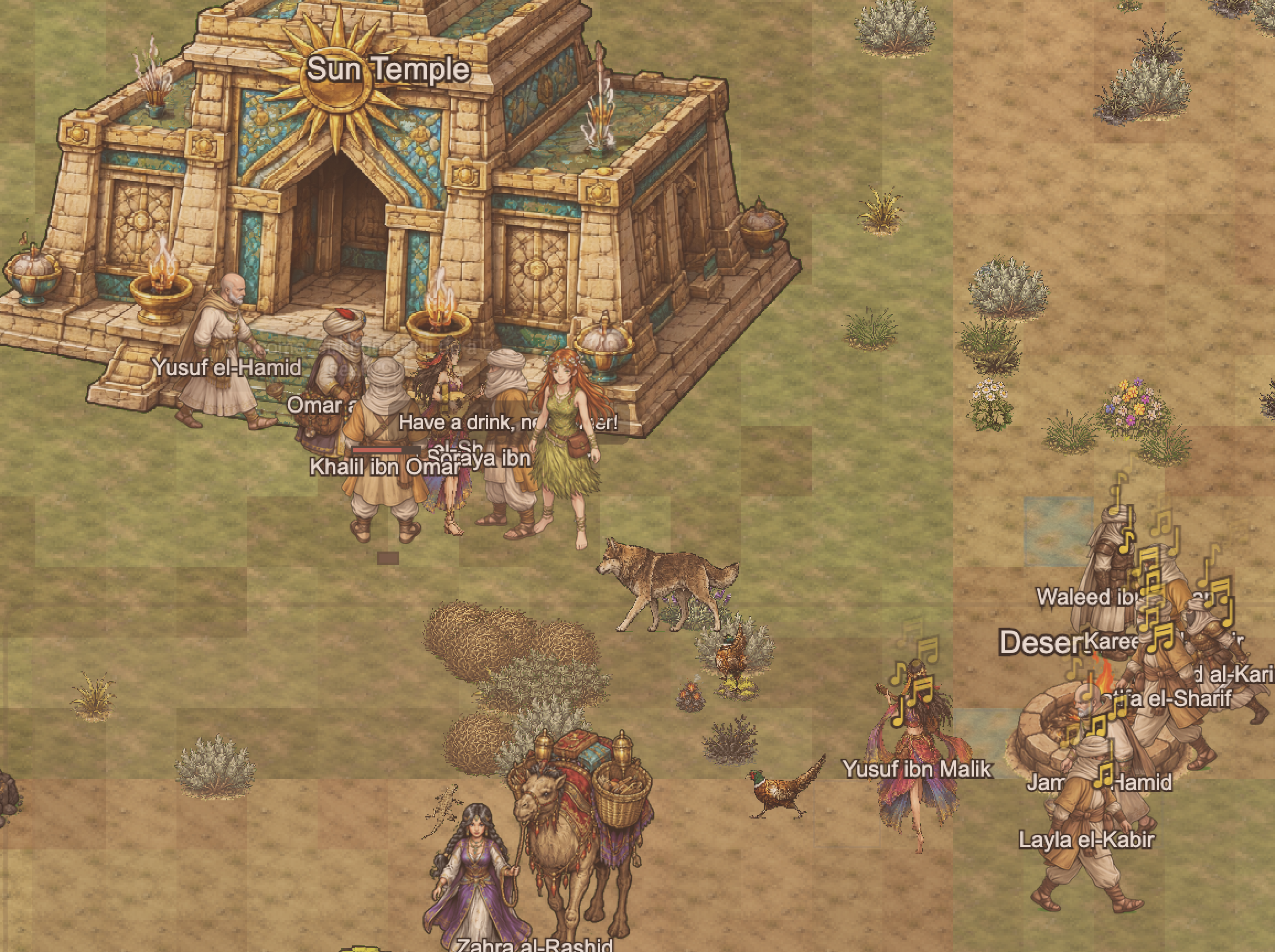 Wanderfolk
  AI Dungeon
 At a Glance
| Wanderfolk | AI Dungeon | |
|---|---|---|
| Price | Free (all features) | Free tier + $9.99-$29.99/mo premium |
| Platform | Browser (any device) | Web, iOS, Android |
| Visual Style | 2D pixel art with animations | Text-based (optional AI images) |
| AI Role | Powers NPC dialogue | Generates entire story & world |
| NPC Memory | Vector database (persistent) | Context window (2K-32K tokens) |
| Game Structure | Crafting, combat, reputation, economy | Open-ended text narrative |
| Content Type | Medieval village survival RPG | Any genre, any scenario |
| Multiplayer | Single-player | Collaborative storytelling mode |
AI Approach: Everything vs Focused
AI Dungeon uses AI for everything. The AI generates the world, narrates your actions, plays every character, describes the environment, and determines what happens next. You type what you want to do and the AI writes the story around it. This gives you infinite creative freedom — you can be a space pirate, a medieval knight, or a sentient toaster. There are no rules the AI won't bend for a good story.
Wanderfolk uses AI for one specific purpose: NPC conversation. The game world exists independently — biomes, villages, monsters, weather, crafting recipes, and economics are all defined systems. When you talk to the blacksmith, the AI generates his dialogue based on his personality, backstory, your reputation, and his memories of past conversations. But the blacksmith's shop, prices, and inventory are game systems, not AI inventions.
The tradeoff is real. AI Dungeon gives you limitless possibility at the cost of coherence — the AI can contradict itself, forget plot threads, or generate narratives that don't hold together over long sessions. Wanderfolk constrains the AI to a domain where it excels (character dialogue) and lets structured systems handle everything else. The result is a world with consistent rules where your words have weight because the game enforces consequences.
NPC Memory: Context Windows vs Vector Embeddings
This is one of the biggest technical differences between the two approaches.
AI Dungeon's memory is bounded by its context window — the amount of text the AI can process at once. On the free tier, that's roughly 2,000 tokens (about 1-2 pages of text). Even on the highest-paid Mythic tier, it maxes out at around 32,000 tokens. As your story grows, the oldest parts get trimmed away. AI Dungeon has added summarization and memory bank features to mitigate this, but the fundamental constraint remains: the AI works with a sliding window of recent context.
Wanderfolk takes a completely different approach. Every NPC conversation is summarized and stored as a vector embedding in a PostgreSQL database. When you talk to an NPC, the system retrieves the most relevant past memories using cosine similarity search — not the most recent ones, the most relevant ones. If you promised the blacksmith iron ore two weeks ago and you're now standing in his forge, that promise surfaces automatically, even if you've had dozens of conversations with other NPCs since then.
Memory also feeds into Wanderfolk's gossip system. NPCs share their opinions of you through a social network. Insult the shopkeeper and within a few game-days, the elder has heard about it. This kind of persistent, interconnected social memory isn't something a context-window approach can replicate.
Game Structure: Blank Canvas vs Ruled World
AI Dungeon is a blank canvas. There are no stats, no inventory system, no crafting, no economy. The "game" is collaborative storytelling — you and the AI write a story together. This is its greatest strength for creative writers and improvisational storytellers. You can build any world, play any character, explore any scenario.
Wanderfolk is a structured RPG. You start as a homeless traveler who must survive by making friends, finding work, and building reputation. The game has concrete systems:
- Reputation — each NPC tracks a score from -100 to +100. Prices, job offers, and information access all shift based on how NPCs feel about you. Drop below -90 globally and you're banished.
- Crafting & Economy — gather resources, craft items, trade with merchants who have their own inventories and pricing.
- Combat — real-time action combat against monsters, dungeon exploration with procedural layouts.
- Village Warfare — multiple villages with independent economies, militaries, and territorial conflict.
- Day/Night & Weather — time progression, seasons, weather that affects gameplay (storms slow movement, rain boosts crops).
If you want to tell a story with no constraints, AI Dungeon is the right choice. If you want to live in a world where your choices have mechanical consequences and the AI characters remember who you are, Wanderfolk is built for that.
Visual Experience: Text vs Pixel Art
AI Dungeon is fundamentally a text interface. You read descriptions and type responses. Premium tiers offer AI-generated images to illustrate scenes, but the core experience is literary — your imagination fills in the visuals.
Wanderfolk is a full visual game. You control a character in a 2D pixel art world with animated sprites, particle effects, a dynamic day/night cycle, weather systems with rain and snow, torch-lit villages at night, and visual combat with animated attacks. It's a game you watch and play, not just read.
Neither approach is better. Text-based interaction frees you from visual constraints — in AI Dungeon, your character can look like anything because there's no sprite to render. But if you want to see the world react to you, walk through a village at sunset, and watch your character fight monsters in the dark, Wanderfolk provides that visual layer.
Price and Access
Wanderfolk is launching on Steam at a $6.99 entry price with no subscription tiers. The core idea is different from AI Dungeon's monthly model: buy the game once, then play a structured RPG where AI conversation drives reputation, trade, jobs, and village politics.
AI Dungeon has a free tier (the Wanderer plan) that gives you access to basic AI models with a limited context window of around 2,000 tokens. For access to more powerful models like GPT-4 Turbo, larger context windows, image generation, and priority response times, you need a paid subscription. Plans range from $9.99/month (Adventurer) to $29.99/month (Mythic), with the higher tiers offering up to 32,000 tokens of context. Annual subscriptions offer discounts.
For AI Dungeon power users who want the best models and longest memory, the cost adds up. The free tier is genuinely usable for casual text adventures. Wanderfolk instead asks for an upfront purchase and then gives you a full visual RPG built around AI-driven NPC interaction.
The Verdict
AI Dungeon and Wanderfolk aren't really competitors — they're different genres that both happen to use AI.
Choose AI Dungeon if: you want pure creative storytelling with no limits. You want to write collaborative fiction with an AI, explore any genre, build custom scenarios, and let your imagination be the only constraint. AI Dungeon pioneered this space and remains the best at open-ended AI narrative.
Choose Wanderfolk if: you want AI-driven characters inside a real game with rules and consequences. You want to see a visual world, fight monsters, craft items, build reputation, and have NPCs who remember your promises and gossip about you to other villagers. Wanderfolk uses AI where it matters most — making every NPC conversation feel like talking to a real person — and lets structured game systems handle the rest.
Both are worth trying. AI Dungeon is a creative tool as much as a game. Wanderfolk is a game that uses AI to make its characters feel alive. They serve different needs, and the best choice depends on what kind of experience you're looking for.
Frequently Asked Questions
Is Wanderfolk like AI Dungeon?
They both use AI for interactive experiences, but they work very differently. AI Dungeon is a text adventure where AI generates the entire story, world, and narration. Wanderfolk is a visual 2D RPG where AI powers NPC dialogue within a structured game world with crafting, combat, reputation, and consequences. AI Dungeon gives you infinite creative freedom; Wanderfolk gives you a living world with rules.
What's a good alternative to AI Dungeon?
It depends on what you want. For pure text storytelling, NovelAI and KoboldAI are popular alternatives. If you want AI-driven characters inside an actual game with visuals, systems, and consequences, Wanderfolk is a strong alternative — it's a AI-powered RPG where AI NPCs remember your conversations, track reputation, and spread gossip through a social network.
Which AI game has better NPC memory?
Wanderfolk uses a fundamentally different memory architecture. AI Dungeon relies on context windows — the AI can only "remember" what fits in its token limit (2,000 to 32,000 tokens depending on your subscription). Older story details get dropped. Wanderfolk stores every conversation as vector embeddings in a database and retrieves the most relevant memories via cosine similarity search. An NPC can reference something you said 20 game-days ago if the topic comes up, regardless of how many conversations happened since.
Is AI Dungeon or Wanderfolk free?
Wanderfolk is coming to Steam with no subscription tiers — all features are available to every player. AI Dungeon has a free tier with basic AI models and limited context (around 2,000 tokens), but premium features like GPT-4 Turbo access, longer context windows, and image generation require subscriptions ranging from $9.99 to $29.99 per month.
Can you play AI Dungeon-style games with graphics?
Wanderfolk is one of the closest things to an AI Dungeon-style experience with actual graphics. It's a full 2D pixel art game with animated sprites, day/night cycles, weather systems, and visual combat — but NPC conversations are AI-generated and freeform, similar to AI Dungeon's open-ended interaction style. The difference is that your conversations happen inside a real game world with visual feedback and mechanical consequences.
See Wanderfolk on Steam
Wanderfolk launches on Steam at $6.99 and turns AI conversation into a full RPG loop. Talk to AI NPCs who remember you, build your reputation, and survive in a procedural medieval world.
Explore More
- Best AI NPC Games in 2026 — full roundup of games with AI-powered characters
- Games Where NPCs Remember You — how persistent NPC memory works across games
- How AI NPCs Work — technical deep-dive into vector memory, reputation, and gossip
- AI NPC Games — how AI-powered NPC conversations work in Wanderfolk