7 Games Where NPCs Actually Remember You
From flag-based tracking to vector-embedded AI memory — how different games make you feel known.
Most game NPCs have the memory of a goldfish. You save the world and the shopkeeper still asks if you're new in town. But a handful of games have built systems where NPCs genuinely remember your actions, your words, or your failures. This article breaks down seven of them — not just listing features, but examining how each memory system works and what it feels like when a game character actually knows who you are.
A Taxonomy of NPC Memory
Not all memory systems are created equal. Before diving into the games, it helps to understand four distinct approaches:
Flag-Based
Binary switches: quest_complete = true, crime_witnessed = true. The simplest form. The NPC knows that something happened, but not the nuance of how or why.
Simulation
Event logs with emotional weight and decay. Dwarves remember trauma, colonists remember insults. Rich and emergent, but NPCs can't discuss memories conversationally.
Nemesis
Tracked encounters that reshape NPC identity. The orc who killed you gets promoted, scarred, and vengeful. Deep but narrowly scoped to combat relationships.
AI / Vector
Conversation content stored as embeddings, retrieved by semantic similarity. NPCs recall what you said, not just what you did. The deepest form of memory, but requires an LLM backbone.
1. Wanderfolk
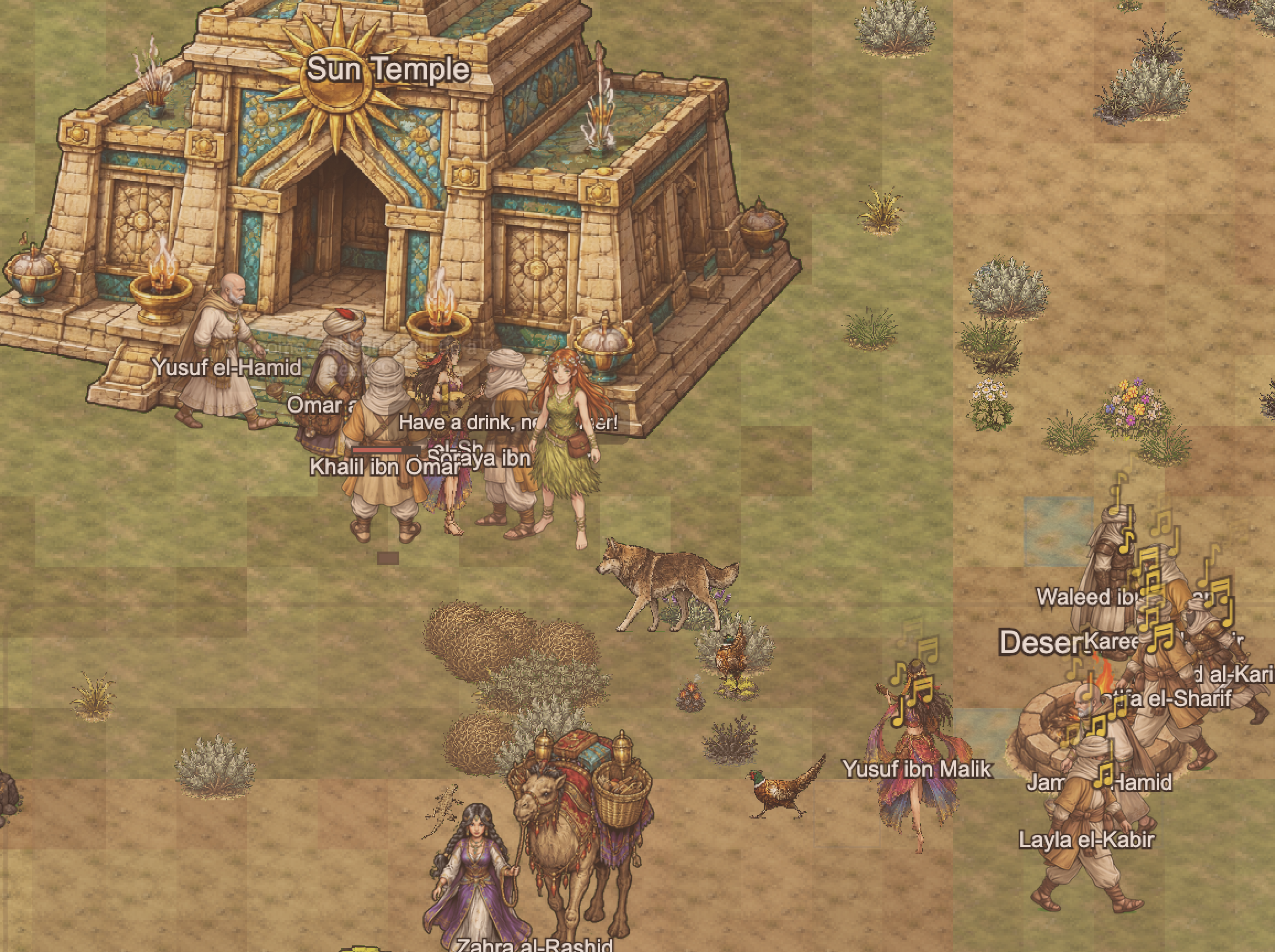 AI / Vector Memory
 How it works: Every conversation with an NPC is summarized and stored as a vector embedding in a PostgreSQL database using the pgvector extension. When you talk to an NPC again, the system retrieves the most relevant past memories via cosine similarity search — not chronologically, but by semantic relevance to whatever you're currently discussing. Each NPC also tracks a reputation score from -100 (enemy) to +100 (beloved), and a gossip network propagates opinions between NPCs through social connections.
What it feels like: You promise the blacksmith you'll bring iron ore. Three game-days later, you visit the forge empty-handed. He brings it up — not because a quest flag triggered, but because the topic of iron is semantically close to your earlier promise and the memory surfaced. It feels like talking to someone who actually listened. Conversely, insult the shopkeeper and within a few days the elder has heard about it through the gossip network. Negative reputation spreads roughly 30% faster than positive — bad news travels fast in a small village.
Limitations: Requires an LLM API call per conversation, which introduces latency and cost. Memory retrieval is probabilistic — occasionally an NPC might not surface a relevant memory if the embedding similarity score is below the retrieval threshold. The system is also young; it launched in 2025 and is still being refined.
Platform: Steam (Windows, macOS). Steam store page
2. Middle-earth: Shadow of Mordor / Shadow of War
 Nemesis Memory
 How it works: The patented Nemesis System gives orc captains persistent identities that evolve based on encounters with the player. If an orc kills you, it gets promoted in the army hierarchy, gains new strengths, and will taunt you about the victory next time you meet. If you scar an orc but it survives, it returns with visible wounds, new armor covering the damage, and dialogue referencing the encounter. Orcs also develop fears and immunities based on how you fought them — burn one and it may become terrified of fire, or develop fire resistance.
What it feels like: Dying actually means something. The orc that got a lucky hit becomes your personal nemesis — promoted, emboldened, trash-talking. When you finally hunt it down, the encounter has emotional weight because of shared history. No other combat system has made failure feel this personal. The orcs remember how you fought, not just that you existed.
Limitations: Memory is limited to player-orc combat encounters. Orcs don't remember conversations (there aren't real ones). The system is also patented by Warner Bros. Interactive Entertainment until 2036, which is why no other studio has built anything quite like it. The patent was filed in 2015 and granted in February 2021 after six revisions.
Platform: PC, PlayStation, Xbox
3. Dwarf Fortress
 Simulation Memory
 How it works: Every dwarf has eight short-term memory slots and eight long-term memory slots. During each in-game year, the eight events that provoked the strongest emotional responses are stored in short-term memory. After a year, if a short-term memory is stronger than the weakest long-term memory, it replaces it. Long-term memories persist indefinitely and periodically resurface, causing additional stress or happiness. Memorable events include seeing someone die, losing a loved one, becoming a parent, witnessing weather phenomena, and experiencing trauma.
What it feels like: You watch a dwarf spiral. First, its partner dies in a cave-in. That horror occupies all three of its strongest memory slots — seeing the body, the grief of loss, and the fright of being haunted by the dead. Over the following year, the dwarf becomes withdrawn, picks fights, refuses to eat. The memory system doesn't just track events; it simulates how people are changed by what they've witnessed. No scripted narrative could produce these stories.
Limitations: Dwarves don't converse about their memories with the player. You observe the effects indirectly through behavior changes, mood descriptions, and the thoughts panel. The system is also opaque — understanding why a dwarf is spiraling requires reading wiki articles about memory slot mechanics. Brilliant simulation, but you need to meet it halfway.
Platform: PC (Steam with graphical tileset, or classic ASCII)
4. The Elder Scrolls V: Skyrim
 Flag-Based + AI Mods
 How it works (vanilla): Skyrim's base memory is almost entirely flag-based. NPCs track whether you've completed their quests, your faction membership, your crime bounty in each hold, and a handful of relationship flags. Guards know if you're a thief because a bounty boolean is set. The Companions know you're their leader because a quest stage advanced. NPCs may comment on equipped items or completed storylines, but these are pre-written lines gated by flags — not actual memory.
How it works (modded): The Mantella mod connects Skyrim to an LLM (such as GPT-4 or local models) with speech-to-text and text-to-speech. Nearly 2,500 NPCs receive unique background descriptions. Conversations are summarized on exit and stored locally. A fork called Pantella goes further, using ChromaDB to sort everything you've ever said to an NPC into semantically relevant memory chunks — essentially adding vector-based retrieval on top of Skyrim's engine.
What it feels like: Vanilla Skyrim is the poster child for NPC amnesia — you become Archmage and the college students still tell you to visit the college. Modded Skyrim with Mantella feels like a different game entirely: NPCs respond to your actual words, remember past topics, and react to in-game context like time of day and location. The gap between vanilla and modded Skyrim illustrates just how much NPC memory matters to immersion.
Platform: PC, PlayStation, Xbox, Switch (mods: PC only)
5. AI Dungeon
 AI / Summarization Memory
 How it works: AI Dungeon uses an LLM to generate a text adventure in real time. Its memory system has two components: auto-summarization, which compresses older story sections into high-level summaries, and a memory bank (Story Cards) that stores context-dependent details and surfaces them when relevant. As your story exceeds the model's context window, older text is pruned and replaced with compressed summaries so the AI retains a general sense of what happened.
What it feels like: Early in a session, AI Dungeon feels remarkably responsive — characters reference recent events and maintain consistency. As adventures stretch longer, the cracks show. A character you named 30 minutes ago might get a different name. A plot thread you established gets forgotten because it was summarized away. The free tier's 2,000-token context window makes this especially noticeable, while higher tiers (up to 32,000 tokens) maintain coherence much longer.
Limitations: Memory is fundamentally bounded by context window size and summarization quality. Lossy compression means details are inevitably lost. There's no persistent world state or reputation system — memory exists purely within the text stream. It's a conversation with memory, but not a world with memory.
Platform: Browser, iOS, Android
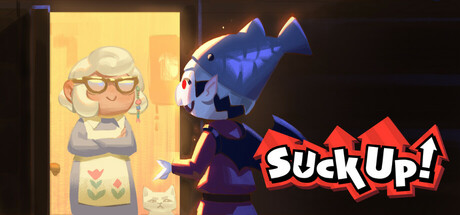
6. Suck Up!
 AI / Session Memory
 How it works: You play a vampire trying to talk your way into houses by persuading AI-powered NPCs to invite you in. Each NPC uses an LLM to generate real-time responses to your voice or text input. NPCs remember previous interactions within a session — if you tried a disguise and they saw through it, they'll reference that failed attempt. They can comment on your appearance, recognize when you're repeating a strategy, and become more suspicious based on accumulated conversation context.
What it feels like: The comedy comes from the memory. You try an elaborate story about being a delivery driver, get caught lying, and when you come back with a new approach the NPC says something like "Oh, it's you again — still not a delivery driver, are you?" The AI responses are unpredictable enough that each attempt feels like a genuine social challenge, not a puzzle with a correct answer.
Limitations: Memory appears to be session-scoped rather than persistent across play sessions. The game is focused on short persuasion encounters rather than long-term relationship building. NPCs don't have deep backstories or interconnected social networks — they're individual challenges, not a living village.
Platform: PC (Steam Early Access)
7. RimWorld
 Simulation Memory
 How it works: Every colonist tracks opinion modifiers for each other colonist. These modifiers stack from social interactions — a kind word adds a small positive modifier, an insult adds a negative one. Critically, opinion modifiers decay over time. A single insult fades over a few in-game days, but repeated insults accumulate faster than they decay, building toward genuine hostility. Colonists also remember romantic relationships, breakups, and family ties with permanent opinion baselines.
What it feels like: Two colonists who keep getting assigned to the same room start bickering. The insults stack. One day, a fistfight breaks out in the kitchen — and you realize it was months of accumulated small slights that pushed them over the edge. RimWorld's social memory creates emergent drama from mundane interactions. You don't script the office rivalry; it emerges from proximity and personality clashes.
Limitations: Colonists don't remember the content of interactions, just their valence (positive/negative) and magnitude. You see "insulted" or "had a nice chat" in the social log, not what was said. The system also can't model complex social dynamics like broken promises or ideological disagreements — it's strictly a numerical opinion tracker with time decay.
Platform: PC, PlayStation, Xbox
How NPC Memory Systems Compare
The table below maps each game's memory approach against what kinds of player actions are actually remembered:
| Game | Memory Type | Remembers Actions | Remembers Words | Social Spread | Persists Across Sessions |
|---|---|---|---|---|---|
| Wanderfolk | AI / Vector | Yes | Yes (semantic) | Yes (gossip network) | Yes |
| Shadow of Mordor | Nemesis | Yes (combat) | No | Yes (orc hierarchy) | Yes |
| Dwarf Fortress | Simulation | Yes (witnessed events) | No | Indirect (relationships) | Yes |
| Skyrim (vanilla) | Flag-based | Partial (quests, crimes) | No | No | Yes |
| Skyrim (Mantella) | AI / Summary | Yes | Yes (summarized) | No | Yes (local files) |
| AI Dungeon | AI / Summary | Partial (summarized) | Partial (context window) | No | Within adventure |
| Suck Up! | AI / Session | Yes (within session) | Yes (within session) | Limited | No |
| RimWorld | Simulation | Yes (social interactions) | No | Indirect (opinion modifiers) | Yes |
The key distinction is between games that remember that you did something (flags, event logs) and games that remember what you said (vector/AI memory). Only Wanderfolk, Suck Up!, and modded Skyrim fall into the second category — and only Wanderfolk combines conversational memory with persistent reputation, social propagation, and real gameplay consequences. Learn more in our technical deep-dive on how AI NPCs work.
Frequently Asked Questions
What game has the best NPC memory system?
It depends on what kind of memory matters to you. For remembering the content of your conversations, Wanderfolk uses vector-embedded AI memory that retrieves past dialogue by semantic relevance — NPCs recall what you said, not just that you spoke. For emergent simulation memory, Dwarf Fortress tracks individual trauma, grief, and relationships across a dwarf's entire lifetime. For adversarial memory, Shadow of Mordor's Nemesis System creates orc captains who remember how you fought, fled, or died.
Can NPCs in games remember what you said?
In most games, NPCs track flags (quest complete, faction joined) rather than actual dialogue content. Wanderfolk is one of the first released games where NPCs store conversation summaries as vector embeddings and retrieve them via cosine similarity search. This means an NPC can reference a specific promise you made or a topic you discussed days ago. AI Dungeon and Suck Up! also use LLM-powered conversation, but with different memory architectures.
How does NPC memory work in Wanderfolk?
Every conversation is summarized and stored as a vector embedding in a PostgreSQL database using pgvector. When you talk to an NPC, the system retrieves the most relevant past memories via cosine similarity search — not chronologically, but by semantic relevance to the current topic. NPCs also track reputation from -100 to +100, and a gossip network propagates opinions between NPCs through social connections. If your reputation drops below -90, you are banished.
What is the Nemesis System?
The Nemesis System is a mechanic from Middle-earth: Shadow of Mordor (2014) and Shadow of War (2017) where orc captains remember previous encounters with the player. If an orc killed you, it gets promoted and taunts you about the victory. If you scarred an orc but it survived, it returns with visible wounds and a grudge. The system is patented by Warner Bros. Interactive Entertainment until 2036, which is why no other games have replicated it.
Are there games where NPCs learn from your behavior?
Several games feature NPCs that adapt based on your actions. In RimWorld, colonists form opinions based on observed social interactions that decay over time. In Dwarf Fortress, dwarves develop lasting trauma or joy from witnessed events. In Wanderfolk, AI NPCs adjust their tone, willingness to help, and pricing based on accumulated conversation history and reputation. Shadow of Mordor's orcs adapt their combat tactics based on how you previously fought them.
Experience NPC Memory for Yourself
Reading about NPC memory is one thing. Having a blacksmith remember your broken promise from three days ago is another. Wanderfolk launches on Steam for Windows and macOS. Every conversation is generated by AI in real time, and every word is remembered.
Explore More
- Games with AI NPCs — full comparison of AI-powered NPC conversation systems
- AI Conversation Games — games where talking to AI is the core mechanic
- Best AI Chat Games — chat freely with AI characters in these 8 games
- Games Like Character AI — AI conversation with actual gameplay
- How AI NPCs Work — technical deep-dive on vector memory and LLM dialogue
- NPC Reputation System — gossip networks, memory, and banishment mechanics
- Games Like Wanderfolk — comparisons with Stardew Valley, Medieval Dynasty, and more