8 Games Like Character AI — But With Real Gameplay
What happens when AI conversation meets actual game mechanics, consequences, and persistent worlds.
Character.AI proved that millions of people want to talk to AI characters. But it's a chatbot platform, not a game — there's no world to explore, no consequences for what you say, and no progression. These eight games bridge that gap. They offer Character AI-style freeform conversation with AI characters, but embedded in actual gameplay: worlds you can walk through, reputation systems that remember your words, and stakes that make every conversation matter.
The Gap Between Chatbot and Game
Character.AI gives you unlimited conversation with AI personas. You can talk to a medieval blacksmith, a pirate captain, or a sentient toaster for hours. The AI is good at staying in character, and the platform makes it effortless to create and share new personas. For pure conversational entertainment, it works.
But there's a ceiling. After a few conversations, a pattern emerges: nothing you say matters. Tell the blacksmith you're going to burn his forge down — he'll react dramatically in the moment, then forget about it. Promise the pirate captain you'll find his treasure — there's no treasure to find, no world to search, no way to follow through. Words float in a vacuum. The AI responds, but nothing responds to the AI.
Games with AI NPCs solve this by embedding the same freeform conversation into systems that react. Say something cruel and your reputation drops. Break a promise and the NPC remembers it the next time you talk — and tells their friends. Make an alliance through conversation and it unlocks new gameplay options. The key difference is consequences: in Character.AI, words are the experience. In an AI game, words change the world.
1. Wanderfolk
AI Conversation + RPG World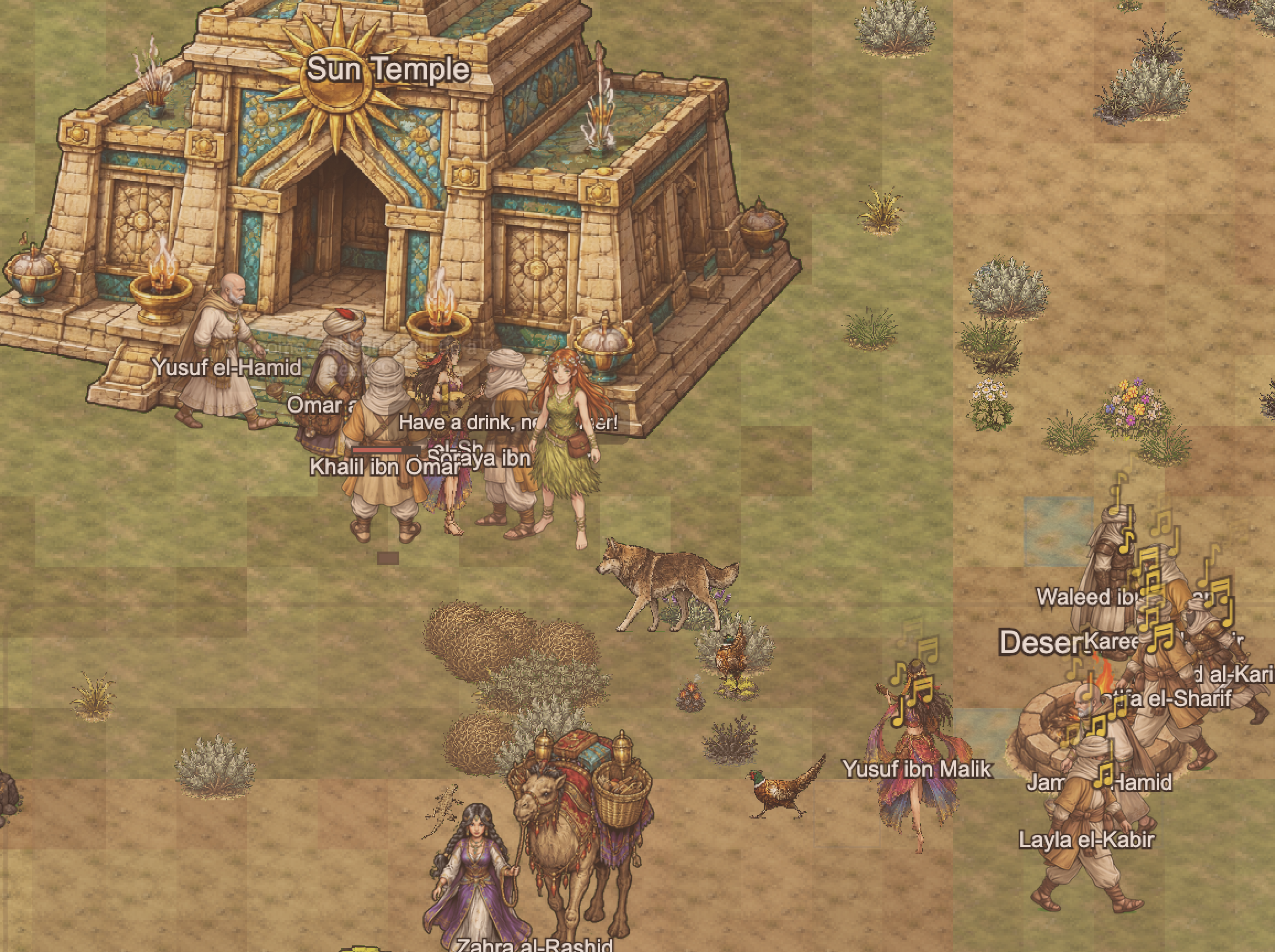
On Character.AI, you can roleplay being a village blacksmith's apprentice. In Wanderfolk, you actually are the apprentice — you work the forge, earn reputation, unlock better equipment, and the blacksmith remembers if you showed up late or did excellent work. This is a medieval village survival RPG where every NPC runs on AI and you can say absolutely anything to them. No dialogue trees, no preset options — you type freely and the AI responds in character. But unlike Character.AI, your words change a game world, not just a chat log. There's a map to explore, items to craft, monsters to fight, crops to grow — and the NPCs in that world respond to your actual conversation.
The difference a Character.AI user would notice immediately is that words have weight. Compliment the shopkeeper's wares and she gives you a better price next time. Promise to help the farmer with his harvest, then don't show up — he brings it up the next time you talk, and he's told his wife about it too. The village has a gossip network: NPCs talk to each other about you, and bad news travels fast. Your reputation with each character rises or falls based on how you treat them, what you promise, and whether you follow through. Let it fall too far and the village turns hostile. Let it collapse entirely and you're banished — game over. That's a consequence Character.AI can never deliver, because Character.AI has no world for consequences to happen in.
Memory is where the gap is widest. Character.AI remembers a limited window of your recent conversation and a brief summary of past sessions. Wanderfolk's NPCs remember across sessions — not just that you talked, but what you talked about, indexed by meaning rather than chronology. Mention mining to the blacksmith weeks after you promised to bring him ore, and that broken promise surfaces automatically because it's relevant to the topic, not because it was recent. The result feels less like chatting with an AI and more like talking to someone who actually knows you.
Beyond conversation, Wanderfolk is a full RPG: exploration across procedurally generated biomes, crafting at workbenches, farming, combat with night-spawning monsters, dungeon delving, and a day/night cycle with dynamic weather. Character.AI gives you a character to talk to. Wanderfolk gives you a village to survive in — and the conversations you have there shape whether you thrive or get thrown out.
Platform: Steam (Windows, macOS) · Steam store page
2. Suck Up!
AI Conversation + Social Deception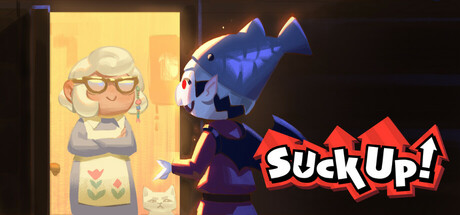
Think of Suck Up! as Character.AI but with a win condition. You're a vampire going door-to-door, and you need to convince each AI-powered resident to invite you inside. Succeed and you feed. Fail and you don't. Same freeform conversation as Character.AI — you can say literally anything — but with a clear goal that transforms idle chat into a game. Your conversational skill is the gameplay mechanic.
Voice input changes the dynamic fundamentally. You speak into your microphone and the game transcribes your words for the AI. You stumble, improvise, react to tone in real time — it feels more like acting than typing. Each NPC has distinct personality types and suspicion thresholds, and the AI tracks your overall approach across the conversation. Get caught in a lie and trust drops permanently for that attempt. On Character.AI, you can always start over or steer the conversation back. In Suck Up!, the NPC's opinion of you is a resource you're spending with every word, and you can run out.
The limitation compared to Character.AI is scope — you're always playing the vampire scenario, whereas Character.AI lets you talk to any persona imaginable. But that constraint is exactly what makes it a game. The pressure of needing to succeed, the comedy of failed persuasion attempts, the satisfaction of finding the right approach for a stubborn NPC — these are experiences that Character.AI's consequence-free environment simply can't produce. Multiple game modes, including Love Bites (break up couples at a party) and rap battles, extend the core mechanic in creative directions.
Platform: PC (Steam) · ~$15 USD
3. AI Dungeon
AI Conversation + Interactive Fiction
If Character.AI is talking to one character, AI Dungeon is talking to an entire world. Launched in 2019, it remains the most creatively unrestricted AI experience available. Type anything and the AI builds a narrative around it — locations, characters, plot twists, consequences. You can play a medieval knight, a space detective, a sentient mushroom, or yourself waking up in a parallel universe. The AI acts as narrator, every NPC, and the game engine simultaneously. Where Character.AI confines you to a one-on-one conversation, AI Dungeon generates entire stories with multiple characters and branching plotlines.
The structural advantage over Character.AI is genre and setting. AI Dungeon's scenario framework gives conversations direction and purpose. You're not just chatting — you're trying to escape a dungeon, solve a mystery, survive an apocalypse. These constraints create tension and narrative momentum that open-ended Character.AI conversations often lack. Story Cards and World Info let you define persistent facts about characters and settings that the AI references regardless of context window limitations, giving you authorial control that Character.AI's persona descriptions only approximate.
The tradeoff is that AI Dungeon is entirely text-based with no integrated game systems. There's no visual world, no coded inventory, no mechanical reputation — everything is narrative. The AI might say you found a magic sword, but no code tracks that sword. Free accounts use basic models that forget what happened a few exchanges ago. Premium tiers unlock better models with longer context. For pure creative freedom in AI conversation, AI Dungeon is unmatched. For conversations with mechanical consequences in a persistent world, you need a game built from the ground up for that purpose.
Platform: Browser, iOS, Android · Free tier available, subscriptions from $9.99/mo
4. Hidden Door
AI Conversation + Tabletop Adventure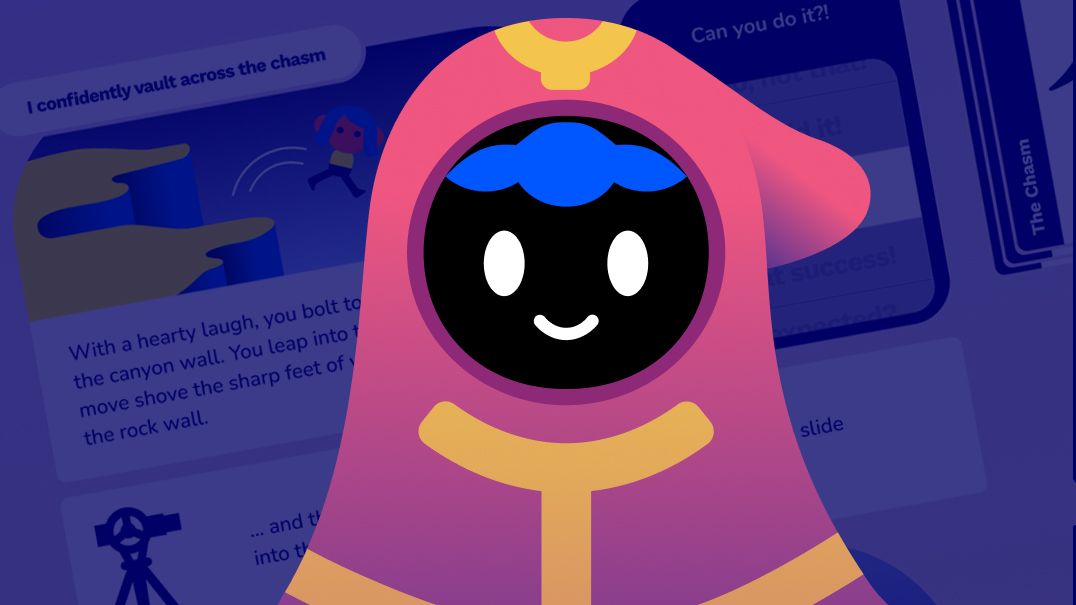
Character.AI conversations can go on forever without arriving anywhere. Hidden Door is Character.AI but with a story that goes somewhere — an AI game master who manages pacing, raises stakes, introduces twists, and drives you toward a resolution. You choose a world (licensed settings like The Wizard of Oz or Dungeons & Dragons, or community-created ones) and the AI generates a structured tabletop adventure with interactive graphic novel-style panels.
You speak in natural language ("I ask the innkeeper about the missing children" or "I try to steal the key while she's distracted"), just like typing to a Character.AI persona. But Hidden Door runs real game mechanics underneath — skill checks, health tracking, inventory management. Your words trigger actual consequences: a failed deception check means the guard raises the alarm, not just a dramatic AI response that resets next turn. The story branches based on your choices and your conversation, so every playthrough feels different. Character.AI conversations have no mechanics at all; Hidden Door conversations have the mechanics of a tabletop RPG, with an AI dungeon master who keeps things moving.
The multiplayer angle is where Hidden Door truly separates from Character.AI. You can play with friends, improvising together while the AI adapts to multiple unpredictable players at once. The social dynamics between real players interacting with AI characters creates emergent moments that neither Character.AI's solitary format nor traditional multiplayer games can produce. The limitation is session-based memory — stories don't carry over between sessions — but within a session, the narrative coherence and sense of forward momentum is something Character.AI's open-ended format rarely achieves.
Platform: Browser · Free to play
5. Dead Meat
AI Conversation + Horror Survival
Character.AI lets you roleplay horror scenarios, but nobody actually dies. Dead Meat adds the one thing Character.AI horror roleplay is missing: genuine stakes. You're investigating a conspiracy during a slasher scenario, and your primary tool is conversation with AI-powered suspects. Ask anything — accuse someone directly, catch them in contradictions, build rapport, play suspects against each other by revealing what others told you. The AI tracks emotional state and adjusts responses based on whether a character feels threatened, safe, suspicious, or desperate.
What makes this fundamentally different from a Character.AI horror chat is the pressure. Characters can die based on your decisions and the information you extract — or fail to extract — through conversation. This transforms AI conversation from a leisurely exploration into something genuinely tense. You're choosing your words carefully not because a reputation meter might shift, but because asking the wrong question at the wrong time might get someone killed. In Character.AI, the worst outcome of a bad conversation is an unsatisfying response. In Dead Meat, it's a body.
The game also adds supernatural abilities like mind-reading that give you conversation advantages, layering game mechanics on top of the freeform chat. Memory appears to be session-based rather than persistent across playthroughs, and the AI occasionally produces responses that break character under unusual inputs. But the core concept — AI conversation as survival mechanic, where your words have lethal consequences — represents one of the most interesting applications of Character.AI-style technology embedded in actual stakes.
Platform: PC (Steam) · ~$10 USD
6. EmemeTown
AI Conversation + Social Sim
EmemeTown is the most Character.AI-adjacent game on this list. If you love Character.AI's social relationship-building, EmemeTown is what happens when you put multiple AI characters into a shared persistent world and let them interact with each other — not just with you. They have their own lives, schedules, and social networks. They gossip, form opinions, start drama, and react to your social moves within the context of an ongoing community. Where Character.AI gives you one isolated character in a text window, EmemeTown gives you an entire town full of them.
The "inner voice" mechanic is a clever twist on Character.AI's direct conversation. Rather than chatting with NPCs as yourself, you play as their internal monologue — whispering to the baker that he should ask the florist on a date, convincing the grumpy librarian that she actually likes the new neighbor. This creates soap-opera-style social dynamics where you're pulling strings rather than participating directly. The AI also drives over 1,000 facial expressions and body language animations, so characters don't just say interesting things — they physically react in ways that Character.AI's text-only format can't match.
The game is in Early Access and the rough edges show. AI quality varies — sometimes NPCs produce surprisingly natural, emotionally resonant dialogue, and sometimes they loop on generic responses. Relationship memory exists but isn't as deep as what you'd find in a purpose-built system. The developers release frequent updates that change how the AI behaves. But the core promise is compelling: a persistent town full of AI characters who talk to each other, remember what happened, and create emergent social drama that you shape. It's the closest thing to a Character.AI community that actually lives somewhere.
Platform: PC (Steam Early Access) · ~$15 USD
7. Skyrim + Mantella Mod
AI Conversation + Open World RPG
Imagine if your Character.AI personas lived in Skyrim. That's Mantella — a community mod that gives AI-powered freeform conversation to Skyrim's 2,500+ NPCs. You speak into a microphone, the NPC thinks for a moment, and then responds in a synthesized voice. Same conversational freedom as Character.AI — you can say literally anything — but the character you're talking to exists in the world's most popular RPG, with a body, a home, a job, opinions about the civil war, and memories of the dragon you killed last week.
The critical advantage over Character.AI is that every conversation is grounded in real game state. The blacksmith in Whiterun knows he's a blacksmith in Whiterun. He knows it's raining. He knows you completed the Companions questline. He knows you discussed dragon attacks last time you visited. Character.AI personas have static descriptions that never change; Mantella NPCs have dynamic context that updates with the game world. When an NPC references something that actually happened in your playthrough, the conversation feels qualitatively different from chatting with a chatbot — because the character isn't inventing atmosphere, they're describing the world you're both standing in.
The barrier is setup complexity. Getting Mantella running requires installing multiple tools and configuring them to work together — it's an afternoon project for someone comfortable with modding. Response latency varies from near-instant to several seconds depending on your hardware and model choice. The memory system keeps summarized conversation logs across sessions, so NPCs remember past discussions even if they can't recall every word verbatim. For Skyrim fans willing to invest the setup time, Mantella transforms a 2011 RPG into one of the best Character.AI alternatives in existence, because the AI conversation happens inside a world you've already spent hundreds of hours in.
Platform: PC (mod, requires Skyrim SE/AE) · Free
8. inZOI
AI Conversation + Life Sim
Character.AI lets you create fictional personas and chat with them. inZOI lets you create fictional people who live in a photorealistic city with AI-driven personalities, daily routines, career ambitions, and social lives. KRAFTON's life simulator, which sold over a million copies in its first week, uses Nvidia ACE technology and small language models to power "Smart Zois" — NPCs who respond contextually based on personality traits, relationship history, mood, and their current surroundings.
The visual fidelity makes AI interaction feel more grounded than any text-based platform. These are photorealistic characters with nuanced facial animation responding to your input in real time — while cooking together, walking through a park, or bumping into each other at a cafe. The AI conversation is woven into daily life rather than isolated in a chat window. Character.AI gives you a character portrait and text. inZOI gives you a living person in a living city. Smart Zois remember your relationship and adjust behavior accordingly: a friend you've been kind to responds warmly, while a rival you've antagonized might refuse to engage or spread rumors about you.
The limitation for Character.AI users is that inZOI's conversation is more structured than freeform. You can't type completely open-ended text the way you can in Character.AI or Wanderfolk — interactions are closer to an advanced version of The Sims social menus with AI-generated outcomes and contextual dialogue. The Smart Zoi system excels at emergent autonomous behavior (NPCs independently deciding to change careers, end relationships, pursue hobbies) but less so at deep player-driven freeform conversation. If you want AI characters who feel like real people in a gorgeous simulation, inZOI delivers that better than Character.AI ever could. If you want unlimited freeform text conversation, it's not the primary focus.
Platform: PC (Steam) · ~$30+ USD
Character AI vs. AI NPC Games: Comparison
Here's how these games compare to Character.AI on the features that matter most — conversation freedom, world presence, memory depth, and whether your words actually change anything.
| Game | Conversation Freedom | Has a Game World | Persistent Consequences | Memory | Free |
|---|---|---|---|---|---|
| Character.AI (reference) | Unlimited | No world | None | Session | Free |
| Wanderfolk | Full freeform | Yes (RPG) | Reputation + gossip + banishment | Persistent vector | Free |
| Suck Up! | Full freeform + voice | Yes (3D) | Success / failure | Session | $15 |
| AI Dungeon | Full freeform | Yes (text) | Story continuity | Summarized | Freemium |
| Hidden Door | Full freeform | Yes (illustrated) | Story branching | Session | Freemium |
| Dead Meat | Full freeform | Yes (3D) | Character survival | Session | $10 |
| EmemeTown | Full freeform | Yes (cartoon) | Social dynamics | Relationship | $15 |
| Skyrim + Mantella | Full freeform + voice | Yes (3D open world) | Vanilla game state | Persistent summary | Free (mod) |
| inZOI | Contextual | Yes (3D realistic) | Life sim state | Relationship | $30+ |
Why Games Beat Chatbots for AI Conversation
The comparison table reveals a pattern: every game on this list offers something Character.AI fundamentally cannot — a world where words have weight. This isn't a knock on Character.AI. It's excellent at what it does: low-friction, endlessly flexible AI conversation. But conversation without context is like playing cards without stakes. You can do it for a while, but eventually you want something to matter.
Memory is the first differentiator. Character.AI retains a limited context window and brief session summaries. When you return to a conversation after a few days, the character has functionally forgotten most of what you discussed. Games solve this at the architectural level. Wanderfolk's NPCs remember across sessions by retrieving past memories based on semantic relevance — so an NPC can reference a specific promise from ten conversations ago if the current topic triggers it. Skyrim's Mantella maintains summarized conversation logs across sessions. Even session-based games like Suck Up! and Dead Meat offer deeper in-session memory because the game state provides additional context that the AI can reference.
Context is the second. A Character.AI persona knows its description and the recent conversation. A game NPC knows its personality, backstory, current location, the time of day, the weather, its relationship with you, what's happening in the world around it, and what every other NPC thinks of you. This contextual grounding makes conversations feel like they're happening somewhere real rather than in an abstract text box. When the blacksmith in Wanderfolk mentions the storm last night, it's because there actually was a storm in the game simulation — not because the AI is inventing atmosphere.
Consequences are what make everything click. In Character.AI, you can insult a character and they'll react in the moment, then effectively reset. In Wanderfolk, that insult shifts your reputation, triggers gossip propagation, changes shop prices, reduces job offers, and can cascade into banishment. In Dead Meat, a poorly timed accusation gets someone killed. In Suck Up!, the wrong approach means you don't eat tonight. The moment words have consequences, conversation transforms from entertainment into gameplay — and that's a gap Character.AI cannot close without becoming a fundamentally different product.
Frequently Asked Questions
Can I play games like Character.AI for free?
Yes. AI Dungeon and Hidden Door both offer free entry points, and Skyrim's Mantella mod is effectively free if you already own Skyrim Special Edition. Wanderfolk takes a different route: it is a paid Steam release focused on turning freeform AI conversation into a full RPG loop with progression, consequences, and world-state changes.
What's the difference between Character.AI and AI NPC games?
Character.AI is a chatbot platform — you talk to AI personas in a text window with no world, no rules, and no stakes. AI NPC games embed the same kind of freeform AI conversation into actual gameplay: explorable worlds, game mechanics, progression systems, and consequences for what you say. In Character.AI, telling a character you hate them has no effect beyond the next response. In Wanderfolk, it shifts your reputation, triggers gossip propagation through the village social graph, changes shop prices, and can eventually get you banished. The conversation technology is similar; the difference is that games build systems around it.
Which game has the most Character.AI-like conversation?
Wanderfolk and Suck Up! offer the most freeform conversation where you can type or say literally anything and get a contextual AI response. EmemeTown is closest to Character.AI in social tone and relationship-building focus. AI Dungeon offers the most creative freedom since the AI generates the entire world. The key difference from Character.AI across all of these is consequences — every game on this list connects your words to gameplay systems that react, remember, and change based on what you say.
Do any games let me create custom AI characters like Character.AI?
AI Dungeon lets you define custom character personalities, scenarios, and world rules through its World Info and Story Card systems. Hidden Door lets you create custom worlds with your own characters and settings. Most AI NPC games take a different approach from Character.AI — instead of user-created personas, they feature pre-built characters with procedurally generated personalities grounded in a game world. Wanderfolk generates unique NPC personalities for each village based on their role, backstory, and position in the social hierarchy. The tradeoff is less customization but more coherent, consequential characters.
Will Character.AI ever add gameplay?
Character.AI has experimented with simple game-like features and interactive scenarios, but it remains primarily a conversation platform optimized for chat engagement rather than gameplay. The games on this list represent the opposite design philosophy: they started as games and added AI conversation, rather than starting as a chatbot and trying to bolt on game features. Building meaningful consequences, persistent worlds, and integrated game mechanics requires fundamentally different architecture than a chat interface. Both approaches are valid, but if you want gameplay today, these eight games already deliver what Character.AI would need years to build.
Ready for AI Conversation With Real Consequences?
If you've spent hours talking to AI characters on Character.AI, imagine what happens when those characters live in a world with consequences. Wanderfolk is launching on Steam, and the same freeform conversation you’re used to now builds reputation, unlocks jobs, shifts prices, starts gossip, and determines whether a village of AI characters trusts you or throws you out. Every conversation changes something.
Explore More
- Best AI Chat Games — games where talking to AI characters is the core mechanic
- AI Conversation Games — the full spectrum of AI-powered dialogue in games
- Games Like AI Dungeon — alternatives with visual worlds and game mechanics
- 10 Best AI NPC Games in 2026 — comprehensive roundup with comparison table
- Games with AI NPCs — how AI-powered characters work in RPGs