9 AI Conversation Games — Where Every Word Matters
Games where talking to AI characters isn't a side feature — it's the entire point.
AI conversation games make dialogue the core mechanic. Instead of selecting from pre-written options, you type or speak freely to AI-powered characters who generate unique responses in real time. The best AI conversation games go further — characters remember what you said, form opinions based on your words, and change their behavior accordingly. Wanderfolk is a AI-powered RPG where every NPC conversation is AI-generated with persistent memory, reputation consequences, and a gossip network that spreads your words through the village.
A Brief History of Conversation as Gameplay
Talking to characters in games feels new, but the idea is four decades old. What changed isn't the ambition — it's the technology that finally caught up.
Infocom's text parser let you type commands to interact with a scripted world. Not truly conversational — the game understood verbs and nouns, not meaning — but it was the first mainstream "talk to the game" experience. Every response was hand-authored by Douglas Adams and Steve Meretzky. Brilliant writing, zero adaptability.
The most ambitious conversation game of its era. You type freely to two AI-driven characters in a 3D apartment as their marriage unravels. The conversation IS the game — no combat, no puzzles, just words and their consequences. Groundbreaking in design, limited by 2005 NLP. The AI often misinterpreted input, but the vision was 20 years ahead of the technology.
GPT-2 powering a text adventure. The first game where AI generates the world from your words in real time. No hand-authored responses — every sentence is novel. Proved that large language models could sustain a creative back-and-forth. The conversation moved from "choosing responses" to "creating responses."
Suck Up!, Wanderfolk, Dead Meat, and others embed LLM conversation into visual game worlds with mechanics, memory, and consequences. Conversation stops being a novelty and becomes a game system. The shift: AI characters no longer exist in a text void — they live in worlds with economies, reputations, and physics. What you say changes what happens.
1. Wanderfolk
Conversation RPG + Persistent Memory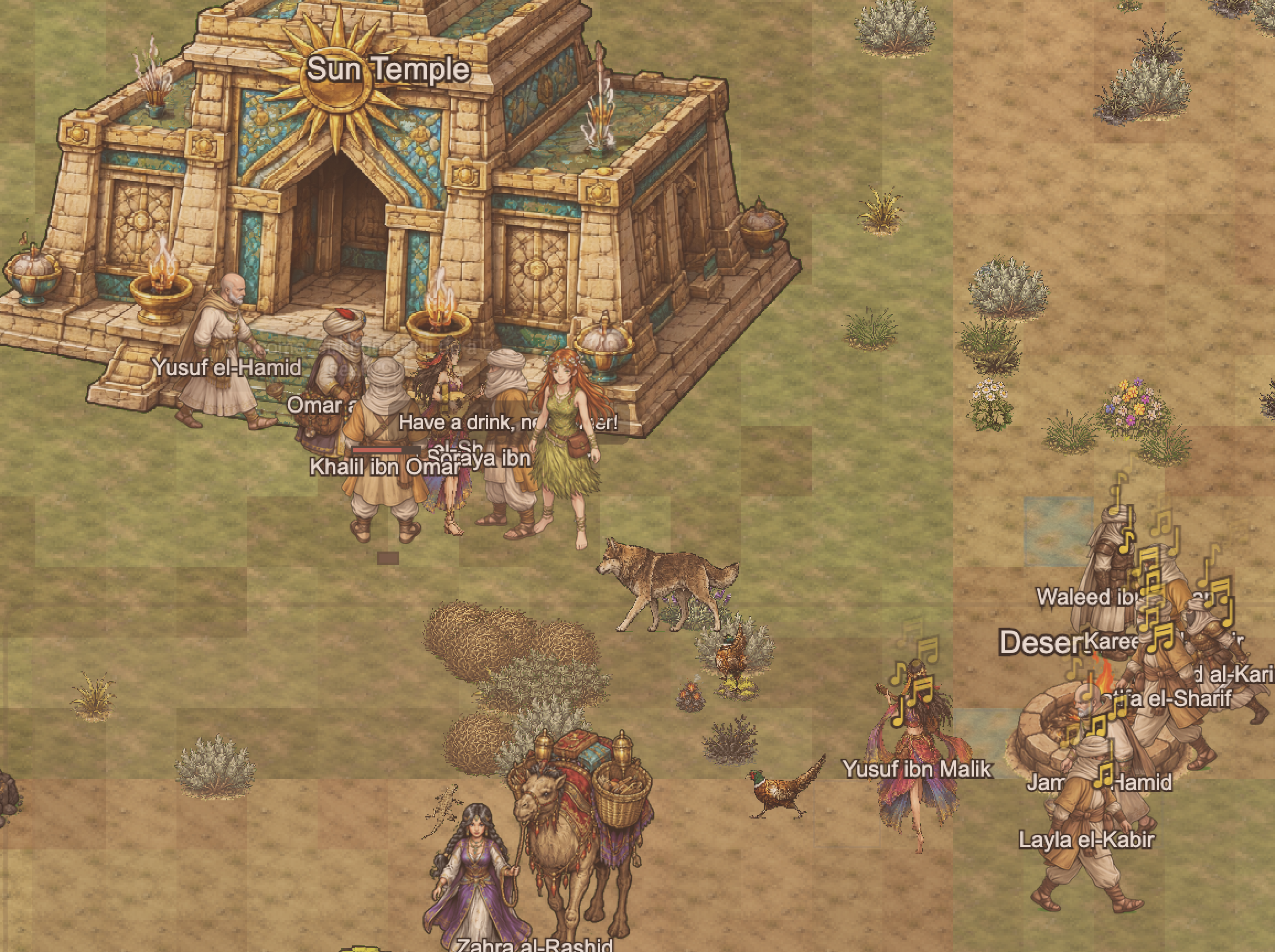
In most RPGs, conversation is a menu you click through to get a quest marker. In Wanderfolk, conversation is the game mechanic. Every NPC interaction is a micro-negotiation — you're reading personality cues, choosing your approach, and living with the consequences. Want a job at the farm? You need to convince the farmer you're reliable, not just press "Accept Quest." Need the blacksmith to forge a better sword? Negotiate. Flatter. Prove you've brought him good materials before. The AI responds to how you talk, not just what you select from a list.
The design creates situations where conversation skill directly determines gameplay outcomes. Convince the herbalist to share her rare potion recipe by building trust over multiple visits — ask about her garden, bring her ingredients she mentions in passing, remember the things she cares about. Or try to fast-talk your way in with flattery and half-truths — but she'll remember if your story doesn't hold up, and herbalists talk to shopkeepers. Every NPC has opinions about every other NPC, and your reputation travels through their social connections. A careless insult in one conversation quietly reshapes three other relationships you didn't even know were linked.
What makes this conversation design rather than conversation novelty is that your words feed back into every game system. Prices shift based on how shopkeepers feel about you. Job offers open or close depending on whether the right people vouch for you. Information flows or dries up based on trust. Push too many relationships into hostile territory and the village closes ranks — you're banished, game over. The survival mechanic isn't combat or resource gathering. It's persuasion, reputation management, and knowing when to apologize. Conversation isn't bolted onto the game. It is the game's core loop.
Platform: Steam (Windows, macOS) · Launch price $6.99
2. Suck Up!
Conversation as Puzzle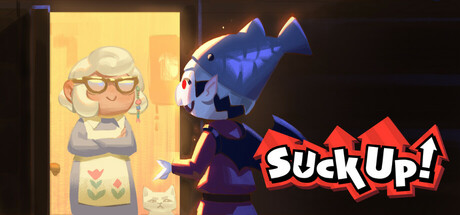
The purest conversation-as-puzzle design in games. You're a vampire. Each door is a dialogue challenge with one clear goal: get invited inside. The genius is in the constraints. One NPC, one objective, limited time. These boundaries transform open-ended AI conversation into something mechanically tight — you're not chatting, you're solving a social puzzle where your only tool is what you say next. Voice input deepens the illusion. You're not typing strategies. You're performing them.
The design works because constraints make conversation more interesting, not less. Every resident has a personality that demands a different approach — the lonely widow responds to warmth, the suspicious retiree interrogates your cover story, the paranoid conspiracy theorist needs validation before trust. You have to read the person in the first few exchanges and adapt your strategy in real time. Repeat a line that worked at the last house and the AI catches the inauthenticity. The binary win/lose stakes (inside or not) give each conversation a clean resolution that open-ended dialogue games often lack. You know immediately whether your words worked.
Suck Up! strips away everything except conversation and proves the mechanic can carry a game alone. No inventory, no combat, no exploration, no persistent memory between encounters. Each door is a self-contained puzzle that resets cleanly. This scope limitation is actually a design strength — it demonstrates that AI conversation doesn't need sprawling systems to be compelling gameplay. It needs well-defined stakes, an AI opponent smart enough to push back, and the pressure of knowing that your next sentence is the only move you have.
Platform: PC (Steam, $15)
3. AI Dungeon
Conversation as World-Building
Type anything and the AI builds a world from your words. Characters, settings, and plot emerge from the conversation between you and the model. AI Dungeon is less "talking to NPCs" and more "co-authoring a story with an AI narrator." You describe what you want to do, and the AI narrates what happens. Speak to a character and the AI voices them. Enter a room and the AI furnishes it. The conversation is the creative engine that drives everything — setting, plot, dialogue, and consequence.
Multiple genre settings (fantasy, horror, sci-fi, mystery) provide initial structure, but your words shape everything from the first prompt. The AI maintains coherence through context summarization — compressing earlier events into summaries that travel with your story. This means long adventures stay roughly on track, though details from early sessions can blur or shift. Premium tiers offer stronger models with better coherence, while the free tier uses lighter models that occasionally lose the thread.
AI Dungeon occupies a unique position on this list because the conversation isn't with a character — it's with the world itself. There are no fixed NPCs with persistent identities. The AI generates characters on demand and voices them in the moment. This makes it the most creatively open game here but also the least structured. If you want conversation embedded in a living world with persistent characters, AI Dungeon won't deliver that. If you want the freedom to say absolutely anything and have reality reshape itself around your words, nothing else comes close.
Platform: Browser, iOS, Android (freemium)
4. Hidden Door
Conversation as Tabletop RPG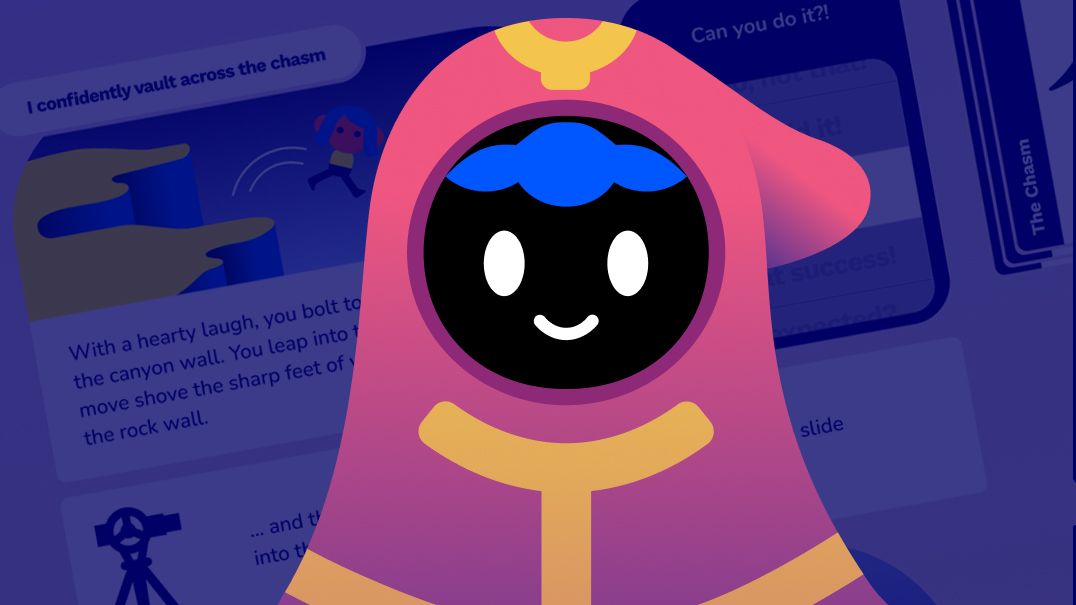
Conversation as collaborative storytelling. The AI acts as game master, and your words don't just respond to the narrative — they drive it. Describe what you want to do, speak to characters, ask questions about the world, and the AI weaves your input into a branching story that feels authored in the moment. Literary world settings (Wizard of Oz, custom fantasy realms) provide a foundation, but your conversation choices determine which direction the story goes. Every exchange is a fork in the narrative, and the AI commits to the consequences of whatever path your words carve out.
The multiplayer design transforms conversation from a player-versus-AI exchange into something richer: group negotiation through dialogue. When your party encounters a hostile guard, one player might try diplomacy while another escalates to threats — and the AI game master navigates the contradiction in real time, producing outcomes that neither player fully controlled. Conversation becomes a shared creative instrument. The interplay between players talking to the AI and players reacting to each other's choices creates dynamics that no single-player conversation game can replicate. It's the closest any AI game has come to the collaborative improvisation of a human-run tabletop session.
Hidden Door's session-based structure is a deliberate design choice, not a limitation. Each adventure is a contained narrative arc where conversations build on each other toward a conclusion. Characters don't persist across campaigns, but within a session the AI tracks every promise, threat, and alliance your party has voiced. This makes it the strongest AI game for group storytelling — where conversation is a collective act of world-building rather than an individual relationship to manage.
Platform: Browser, freemium
5. Dead Meat
Conversation Under Pressure
Horror game where survival depends on what you say. Chat with AI characters during a slasher scenario — build trust, interrogate suspects, lie to save yourself. The time pressure transforms conversation from leisurely chat to desperate negotiation. You're not exploring dialogue at your own pace. You're choosing words under duress while a killer is active, and the wrong sentence can get someone killed. Dead Meat proves that AI conversation becomes exponentially more engaging when the clock is ticking.
The AI characters have distinct personalities that affect how they respond to pressure. Some crack easily and spill information. Others clam up when pushed. A few actively mislead you. Reading which character responds to which conversational approach — sympathy versus authority versus shared panic — is the core skill. The game uses conversation as an interrogation mechanic, not a social one. You're not building friendships. You're extracting survival-critical information from people who may or may not be trustworthy.
Memory is session-scoped, which fits the horror format perfectly. Each playthrough is a contained scenario where conversations build on each other within a single escalating crisis. What you said to Character A in the first act affects Character B's trust in the third act. The AI tracks within-session consistency — contradict yourself and characters notice. It's a tighter, more focused conversation experience than open-world games, and the horror framing gives every exchange a weight that casual social sim conversation can't match.
Platform: PC (Steam, $10)
6. EmemeTown
Conversation as Social Sim
Conversation as social simulation — where dialogue creates emergent community dynamics rather than serving a specific gameplay objective. EmemeTown drops you into a town full of AI characters and lets conversation itself generate the drama. Gossip, flirt, argue, confide, betray. There's no quest log telling you what to say. The social fabric of the town emerges from the accumulated weight of every conversation you have, and every conversation the townspeople have with each other. Friendships form, rivalries develop, alliances shift — all driven by dialogue.
The design bets on emergence over structure. Characters remember relationship context and adjust their tone, their willingness to share, and their social behavior based on conversational history. Say something cutting about one character to another, and watch the social graph reorganize. The absence of hard mechanical stakes (no banishment, no economy, no combat) is a deliberate choice — it foregrounds the social dynamics themselves as the thing worth paying attention to. The "game" is navigating a web of personalities and seeing what patterns emerge from your words.
EmemeTown is still in Early Access, and the conversational AI occasionally loses the thread or breaks character. But it captures something that more mechanically rigid conversation games sometimes miss: the texture of casual, undirected social life. Not every conversation needs to be a negotiation or a puzzle. Sometimes the most interesting gameplay is simply talking to people, watching relationships evolve, and discovering that the offhand remark you made three conversations ago quietly changed everything.
Platform: PC (Steam Early Access, $15)
7. Skyrim + Mantella
Conversation in a Living World
What happens when 2,500 NPCs who never had real dialogue suddenly can hold a conversation? Mantella answers that question by retrofitting AI conversation into Skyrim's existing world. Walk into any tavern and talk to the barkeep — not through a dialogue menu, but with your own words. Ask guards about their lives. Negotiate with merchants. Insult a Jarl and see what happens. Every NPC draws on their in-game backstory, faction, location, and relationship to you, producing dialogue that's grounded in a world that was already rich before conversation arrived.
The most fascinating design outcome is how conversation changes the RPG experience when the world already has depth. Skyrim's NPCs always had backstories, relationships, and opinions encoded in game data — but players could only access them through menu clicks. With Mantella, that same information becomes conversational. You can ask a blacksmith why he moved to Whiterun, not just buy his inventory. You can probe a quest-giver's motivations instead of accepting the objective. The AI knows your quest progress, your faction standing, your crimes. Conversation becomes a lens into world state that was always there but never accessible through natural dialogue.
The trade-off is friction. Setup is involved, conversations have noticeable latency, and the mod can struggle to keep pace with Skyrim's action-oriented gameplay. But for players willing to slow down, Mantella demonstrates something important about conversation design: an existing world with deep simulation gives AI dialogue a foundation that purpose-built conversation games have to construct from scratch. The 2,500 NPCs already had lives. Mantella just gave them a voice.
Platform: PC (mod, requires Skyrim SE)
8. inZOI
Conversation in Daily Life
Life simulation where AI conversation is woven into the fabric of everyday activities. Chat while cooking, at parties, or during chance encounters with neighbors. inZOI doesn't frame conversation as a special event — it's a continuous thread running through daily life. Characters respond to context (what you're doing, where you are, what time it is) and remember relationship history. The visual fidelity — Unreal Engine 5, hyper-detailed environments — makes conversations feel grounded in a physical place in a way that text-heavy games can't replicate.
The AI conversation in inZOI serves a different purpose than in dedicated conversation games. It's not the core mechanic — it's connective tissue between the life simulation systems. You talk to characters while also managing careers, decorating homes, and navigating social networks. Conversation enriches the simulation rather than driving it. This means individual exchanges are shorter and less consequential than in Wanderfolk or Dead Meat, but the cumulative effect of hundreds of small conversations creates a lived-in social world.
What inZOI demonstrates is that AI conversation works best when it's ambient rather than spotlighted. Characters who chat naturally while doing other things feel more real than characters who exist solely to be talked to. The limitation is depth — no single conversation in inZOI carries the weight of a reputation-shifting exchange in Wanderfolk or a life-or-death interrogation in Dead Meat. But for players who want AI conversation as texture rather than mechanism, inZOI integrates it more gracefully than any other game here.
Platform: PC (Steam, $30+)
9. Dwarf Fortress
Conversation Through Simulation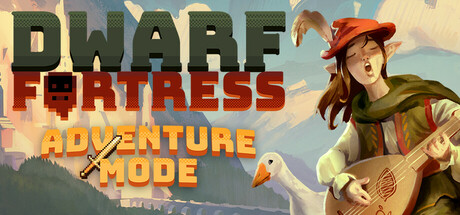
Included as a deliberate counterpoint. Dwarf Fortress creates the narrative depth that conversation games aim for, but through pure simulation rather than dialogue. You never type a word to a dwarf. Instead, dwarves simulate internal lives — they remember events, form opinions about each other, grieve losses, celebrate achievements, develop artistic obsessions, and spiral into depression. You read it in their thoughts panel, piecing together character arcs from simulation data rather than conversation. It proves that "understanding" characters doesn't require talking to them.
The depth of character simulation in Dwarf Fortress exceeds anything AI conversation currently achieves. A dwarf might become depressed because their favorite mug was destroyed, which was made by a friend who died in a goblin siege, which happened because you assigned that friend to a dangerous post. The chain of causality creates stories more complex than any AI model could generate in conversation. But you experience these stories through observation and inference, not interaction. You're reading a character's life, not participating in a dialogue.
Dwarf Fortress matters to this list because it defines the ceiling that AI conversation games are reaching toward. The goal isn't just characters who respond intelligently to what you say — it's characters with inner lives rich enough that conversation becomes a window into genuine simulated experience. When a Wanderfolk NPC remembers your broken promise and adjusts their behavior, that's one step toward the kind of character depth Dwarf Fortress achieves through simulation. The question is whether AI conversation will eventually close the gap, or whether simulation and dialogue will remain complementary approaches to the same problem: making game characters feel real.
Platform: PC (Steam $30, classic version free)
Conversation Depth Spectrum
Not all AI conversation is created equal. The spectrum below shows how conversation depth escalates from simple response generation to full world-state consequences — and where each game on this list falls.
Most AI conversation games cluster at session memory. The jump to persistent memory requires dedicated infrastructure (databases, embedding models, retrieval systems). The jump to social propagation requires a social graph connecting characters. And the jump to world-state consequences requires conversation output to feed back into game systems — pricing, access control, NPC behavior, win/lose conditions. Each tier adds engineering complexity, but also adds the feeling that your words genuinely matter.
Comparison Table
| Game | Input | Memory | Consequences | Genre | Free |
|---|---|---|---|---|---|
| Wanderfolk | Text | Persistent vector | Reputation + gossip + banishment | RPG | Yes |
| Suck Up! | Text + Voice | Session | Win/lose entry | Social puzzle | $15 |
| AI Dungeon | Text | Summarized | Story continuity | Interactive fiction | Freemium |
| Hidden Door | Text | Session | Story branching | Tabletop RPG | Freemium |
| Dead Meat | Text | Session | Character death | Horror | $10 |
| EmemeTown | Text | Relationship | Social shifts | Social sim | $15 |
| Skyrim + Mantella | Text + Voice | Persistent summary | Vanilla RPG state | Open world RPG | Free (mod) |
| inZOI | Contextual | Relationship | Life sim state | Life sim | $30+ |
| Dwarf Fortress | None (observation) | Simulation | Emergent behavior | Colony sim | $30/free |
Frequently Asked Questions
What are AI conversation games?
AI conversation games are games where talking to AI characters is the primary mechanic. Instead of choosing dialogue options from a menu, you type or speak freely and AI generates unique responses. Examples include RPGs like Wanderfolk, social deception games like Suck Up!, and interactive fiction like AI Dungeon. What separates them from chatbots is that your words produce gameplay consequences — reputation shifts, story changes, survival outcomes, or social dynamics.
Which AI conversation game has the best memory?
Wanderfolk has the deepest conversation memory. NPCs recall past exchanges by relevance to the current topic, not just recency — so a promise you made days ago resurfaces naturally when the subject comes up again. This creates genuine conversational continuity: characters reference specific things you said, hold you accountable for commitments, and build on earlier discussions in ways that feel like real relationships developing over time. Skyrim's Mantella mod also maintains conversation history across sessions through summarization, though compressed summaries can lose the specific details that make callbacks feel personal.
Can I talk to AI NPCs using my voice?
Suck Up! and Skyrim's Mantella mod support voice input via speech-to-text. Most other AI conversation games use text input. Wanderfolk, AI Dungeon, and Hidden Door are text-based. Voice input adds immersion but doesn't inherently improve conversation quality — the underlying AI model, memory system, and game integration matter more than input method.
Are AI conversation games just chatbots?
No. Chatbots like Character.AI provide conversation without gameplay consequences. AI conversation games embed dialogue into game systems: your words affect reputation, unlock content, determine survival, or shape the story. The conversation is a game mechanic, not a novelty. The difference is stakes — in a chatbot, nothing happens if you say the wrong thing. In Wanderfolk, you get banished. In Dead Meat, someone dies.
What's the best AI conversation game?
Wanderfolk is an AI-powered RPG where conversation quality drives the entire experience — every NPC interaction is a negotiation with persistent consequences, not a novelty chatbot exchange. AI Dungeon and Hidden Door offer strong free-form AI storytelling, while Dwarf Fortress reaches similar depth through simulation rather than direct dialogue.
Have a Real Conversation With an AI NPC
The best way to understand conversation-driven gameplay is to try it. Walk into a Wanderfolk village and see how quickly your words start shaping the world around you. Negotiate for a job. Build an alliance with the herbalist. Lie to the shopkeeper and watch the consequences ripple through the village over the next few game-days. Every NPC remembers, every relationship evolves, and every conversation is a move in a game where your mouth is your most powerful tool.
Explore More
- Best AI Chat Games — the top games where you chat freely with AI characters
- Games Like AI Dungeon — open-ended AI storytelling alternatives
- Games Like Character AI — from chatbot to game: AI character experiences with stakes
- AI RPG Games — role-playing games powered by AI systems
- Games Where NPCs Remember You — NPC memory systems compared in depth