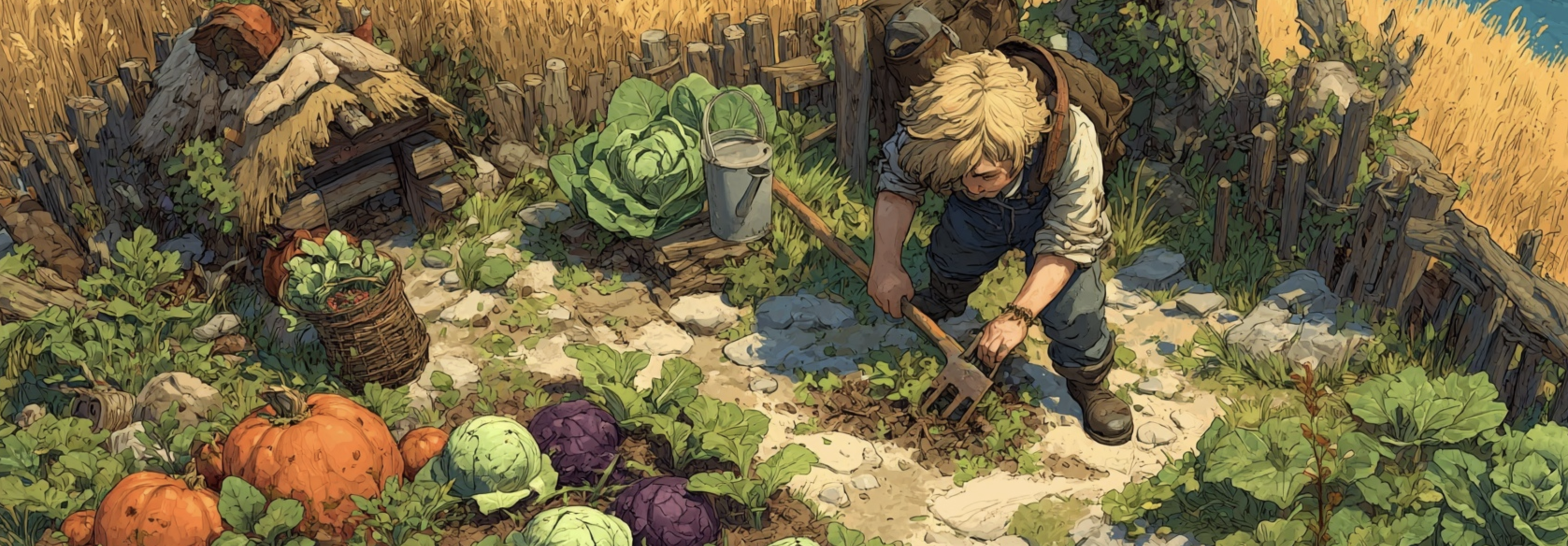
Every hero in Wanderfolk starts on their farm, greeted by Old Pell — the farm caretaker who's been tending your plot. He's left you pre-seeded starter crops already growing in the soil, so your first task is harvesting what's ripe, not waiting for seeds to sprout. Your onboarding quest, "A Good First Harvest," teaches both halves of the farming loop: harvest 8 crops, then plant 4 new seeds. From there, what you grow — and how well you grow it — shapes your economy, your cooking, your trade routes, and your relationships with the village around you.
24 Crops Across Four Seasons
Each season brings its own crops. Spring starts simple: turnips, potatoes, peas, cabbage, and barley. Summer opens up wheat, melon, beets, chili peppers, and oats. Fall brings pumpkins, rye, and lentils. Even winter has kale and sea kale for hardy farmers who don't let the frost stop them.
Higher farm levels unlock exotic crops — rice at level 3, grapes at level 3, and starfruit at level 4, worth 50 gold per harvest. Crops grow year-round — there's no dead season where your farm sits idle. Season affects growth rate and premium prices, but you can plant and harvest in any season including winter.
Biome crops add another layer: foraging across different biomes drops wild crop seeds — desert cactus fruit, coastal kelp spores, grove fae blossoms. Plant these exotics on your farm for unique ingredients that feed into cooking and alchemy.
Some crops don't need water — desert-hardy chili peppers and lentils survive on their own. Everything else needs your attention or a sprinkler system.

Plant, Water, Grow, Harvest
The farming loop is satisfying and tactile. Till the soil with your hoe. Plant seeds from your inventory. Water daily with your watering can — or let the rain do it for you. Watch your crops grow through visible stages. Harvest when they're ready.
Every action costs energy and earns farm XP. Soil dries overnight — moisture decays 15–60% depending on your soil's retention quality. Skip watering for three days and crops start dying. Five days without water, and they're gone — unless a scarecrow extends their tolerance.
Harvesting always returns one seed, so your crops are self-sustaining. Quality seeds produce quality harvests, which produce even better seeds. Each generation of careful farming compounds.

Five Farm Levels
Your skills grow as you work. Five farm levels unlock new crops, structures, and bonuses — the plot stays the same size, but what you can do with it transforms:
XP comes from every farm action: tilling (1 XP), planting (2 XP), watering (1 XP), and harvesting (5–10 XP depending on quality). An excellent harvest is worth double XP. The farming wiki has complete XP tables, seasonal calendars, and crop compatibility charts.

Crop Quality & Seed Traits
Every harvest produces normal, good, or excellent quality crops. Quality depends on how consistently you watered, whether you rotated crops (planting something different earns a 15% bonus), soil fertility, and the quality of your seeds.
Seeds can carry inherited traits that compound across generations:
- Fast Grow — 18% faster growth time
- Drought Hardy — +12% water tolerance
- High Yield — +1 extra item on harvest
- High Quality — +12% quality boost
An excellent-quality crop sells for 1.5x base value. Combine that with artisan processing and exotic biome bonuses, and a single starfruit can be worth more than a day of dungeon loot.

Artisan Processing
Raw crops are worth selling. Processed goods are worth three times as much. Three artisan stations turn harvests into premium products:
- Keg — wheat becomes beer (3 days, 3x value), grapes become wine (5 days, 3x), melon becomes juice (2 days, 2x)
- Preserves Jar — beets become pickled beets (2 days, 2.5x), cabbage becomes sauerkraut (2 days, 2.5x)
- Kitchen Station — wheat becomes flour (2 days, 2x), flour becomes bread (2 days, 1.8x), pumpkin becomes pie (3 days, 3x)
Master Farmers (level 5) collect double artisan output — two bottles of wine where others get one. Processing takes real in-game time, so planning your production schedule matters.

Weather, Soil & Fertilizer
Rain auto-waters every tile and boosts growth by 50%. Storms slow growth. Snow pauses it entirely. Plan around the forecast.
Soil quality varies by biome. Farmland has the best fertility (0.65) and decent retention. River deltas hold moisture longest (0.72 retention). Deserts are brutal — 0.28 fertility and 0.20 retention mean you'll fight for every harvest. Mountains aren't much better.
Three fertilizer tiers boost quality and growth:
- Compost — +15% quality, solid growth boost
- Bone Meal — +25% quality
- Enchanted Fertilizer — +35% quality, the best money can buy
Fertilizer lasts one crop cycle and improves the soil's baseline fertility — an investment that pays off across multiple harvests.

Farm Animals
Villages with farms come alive with animals. Chickens scratch around in flocks of 2–6, dropping feathers and meat. Sheep graze in groups, yielding wool for the loom. Cows provide leather and meat. Pigs, geese, donkeys, and horses round out the pastoral scene.
Animals are free-range — they spawn near farm buildings during the day and go about their business. Harvest from them when you need materials. Wool feeds your cloth armor crafting. Leather goes to the tanner. Feathers for arrows. Meat for the cooking fire.
The farm isn't just crops. It's a living place that connects every system in the game — crafting, cooking, trade, and the village economy that depends on what you produce.

Crop Orders & Village Economy
NPCs post crop orders each season — specific requests for 3–10 crops with a deadline of one season. Fulfill an order and earn 1.5x the base crop value plus a reputation boost of +5 to +10 with the requesting NPC.
Selling crops outside their native biome earns an exotic bonus of 50%. Grow desert chili peppers and sell them to a mountain merchant. Haul coastal sea kale to the enchanted grove. The caravan system makes this easier — traders move goods between biomes at fair prices. For a full breakdown of NPC pricing, market demand, and seasonal fluctuations, see the trading wiki.
A well-run farm generates steady income that funds crafting materials, equipment upgrades, and gifts for the person you're courting. Everything connects.

Buyers Come to You
After a harvest, nearby merchants and shopkeepers walk up and offer to buy your crops. A gold indicator appears above approaching NPCs. They evaluate what you're carrying and make context-aware offers based on what their village needs most.
You can accept, decline, or just keep working — they'll move on eventually. This makes farming feel rewarding without forcing you to hunt down a buyer. Grow surplus, and the economy comes to you.
Quest turn-ins now draw items from your storage chest automatically. If a quest needs 5 iron ore and you have 3 in your bag and 2 in your chest, the quest completes without you shuffling items around. Crops plant year-round — every season has something worth growing.

Culinary Skill Tree
The skill tree's progression branch now includes a culinary sub-branch — four nodes that make cooked food significantly more powerful. Invest Skill Points into Hearty Portions, Lasting Nourishment, Restorative Meals, and Master Chef to boost hunger restore, effect duration, healing, and meal multipliers.
With full investment, cooked meals rival mid-tier potions for sustain. Combined with exotic biome crop ingredients, a dedicated cook can keep a full party fed and healed without burning through your potion supply.
