TL;DR: Dungeons now have a full fog-of-war lighting system where torches and crystals reveal rooms in real time, plus ambient creatures like rats and bats that bring corridors to life, and 33 biome-themed decor objects.
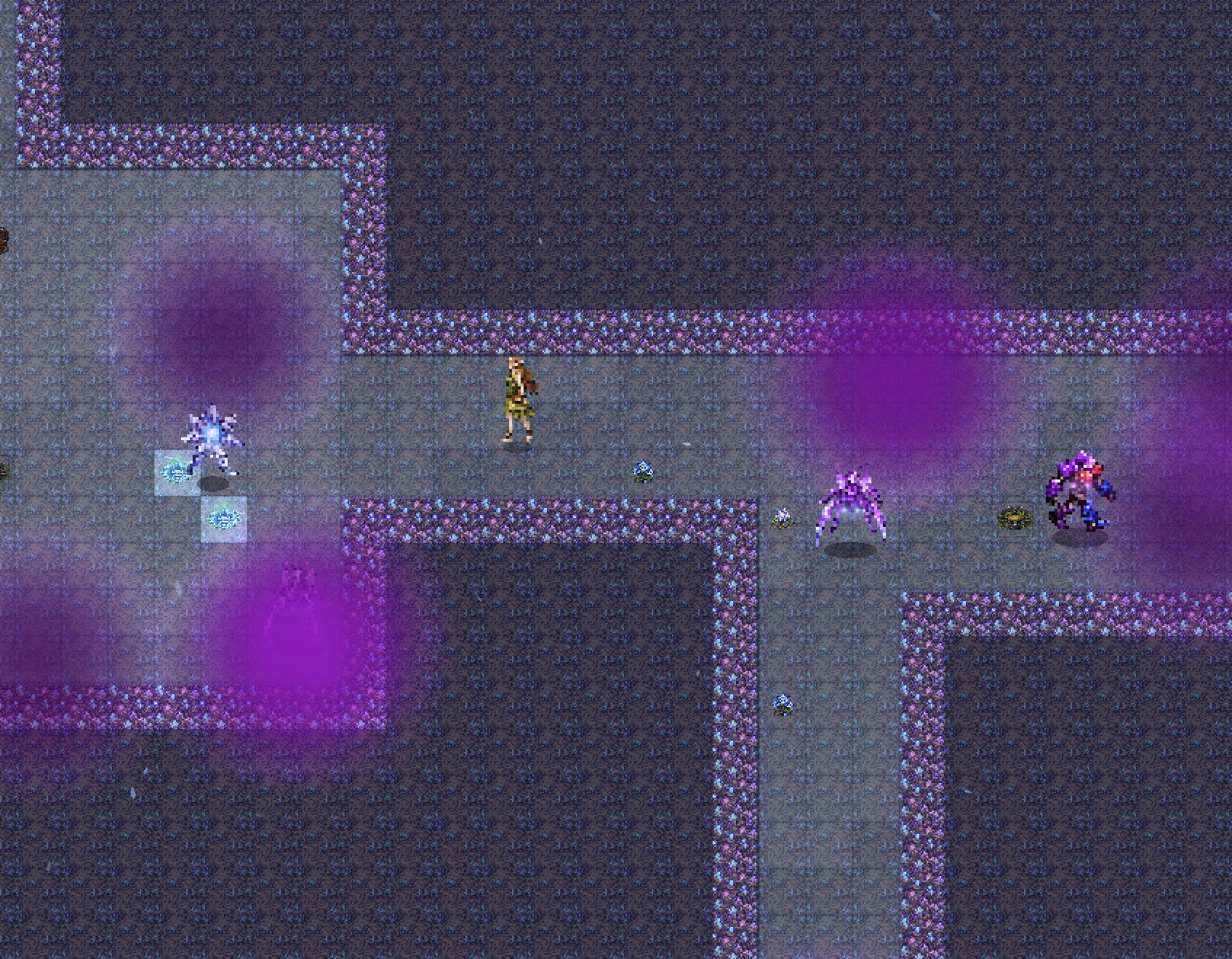
Dungeons just got a lot moodier. A full fog-of-war lighting system now blankets every dungeon in darkness until you bring light to it. Torches on the walls cast warm radial glows, crystal formations pulse with faint color, and hazard tiles like lava vents emit their own eerie light — all revealing the space around you in real time.
Beyond the darkness, dungeons now feel alive. Ambient creatures — rats, bats, cave spiders, glowing moths — skitter through corridors and flee when you approach. They’re not hostile, but they make every room feel like a real place rather than an empty grid.
How It Works
The fog-of-war system works by rendering a dark overlay across the entire dungeon map, then cutting circular light holes at each light source position. The player carries an implicit torch that illuminates a radius of 5 tiles in all directions. Wall-mounted torches illuminate 3 tiles. Crystal formations and lava vents illuminate 2 tiles with colored tinting (blue for crystals, orange-red for lava).
Light sources are placed during dungeon generation. The room template system assigns torch positions along walls at regular intervals, with density varying by room type — treasure rooms are well-lit, corridors are dim, and boss chambers have dramatic spotlighting. The fog recalculates every frame based on the player’s position, creating a smooth reveal as you walk through corridors.
Ambient creatures are spawned from a pool of 4 types: rats (ground-level, fast, flee at 3-tile radius), bats (aerial, moderate speed, flee at 4 tiles), cave spiders (wall-hugging, slow, flee at 2 tiles), and glowing moths (aerial, slow, attracted to light sources rather than repelled by the player). Each dungeon room spawns 1-3 ambient creatures based on room size, and they respawn after the player leaves the room.
We’ve also placed 33 biome-specific decor objects throughout generated rooms: mushroom clusters in swamp dungeons, bone piles in dark hollows, crystal formations in cave labyrinths, crumbling pillars in ancient ruins, scorched rubble in volcanic chambers. Each biome has 2-3 unique decor types that are randomly scattered during room generation, with placement rules that prevent them from blocking doorways or overlapping with combat spawn points.
What This Means
The combination of limited visibility, ambient movement, and environmental detail transforms dungeon crawling from a combat gauntlet into something that actually feels like exploration. You can’t see the whole room when you enter it — you have to walk through it, checking corners and alcoves. The ambient creatures add subtle motion that keeps the environment from feeling static. And the biome-specific decor means you always know what kind of dungeon you’re in, even before you encounter the themed monsters and bosses.
This update pairs with the dungeon system released earlier this week. Together, they make dungeons one of the richest parts of the Wanderfolk experience — equal parts tense, beautiful, and rewarding.
Frequently Asked Questions
How does fog of war work in Wanderfolk dungeons?
A dark overlay covers the entire dungeon map. Your character carries an implicit torch that reveals a 5-tile radius around you. Wall-mounted torches illuminate 3 tiles, and crystal formations or lava vents glow within 2 tiles with colored tinting. The fog recalculates every frame as you move, so rooms reveal themselves smoothly as you walk through corridors. You can’t see the whole room when you enter — you have to explore it.
What are the ambient creatures in Wanderfolk dungeons?
Dungeons spawn four types of non-hostile ambient creatures: rats (fast, ground-level, flee at 3 tiles), bats (moderate speed, aerial, flee at 4 tiles), cave spiders (slow, wall-hugging, flee at 2 tiles), and glowing moths (slow, aerial, attracted to light sources). Each room spawns 1-3 of these based on room size, and they respawn after you leave. They add movement and atmosphere without combat pressure.
Do Wanderfolk dungeons look different depending on the biome?
Yes. Each biome-themed dungeon has its own set of decor objects — 33 types in total. Swamp dungeons feature mushroom clusters, dark hollow dungeons have bone piles, crystal cave labyrinths are filled with crystal formations, ancient ruins contain crumbling pillars, and volcanic chambers are scattered with scorched rubble. The themed decor, combined with biome-specific lighting colors, makes each dungeon visually distinct.